Are AI data centres bad for the environment?
AI data centres can strain electricity and water systems, but impacts depend on design, location, energy and what the computing achieves.
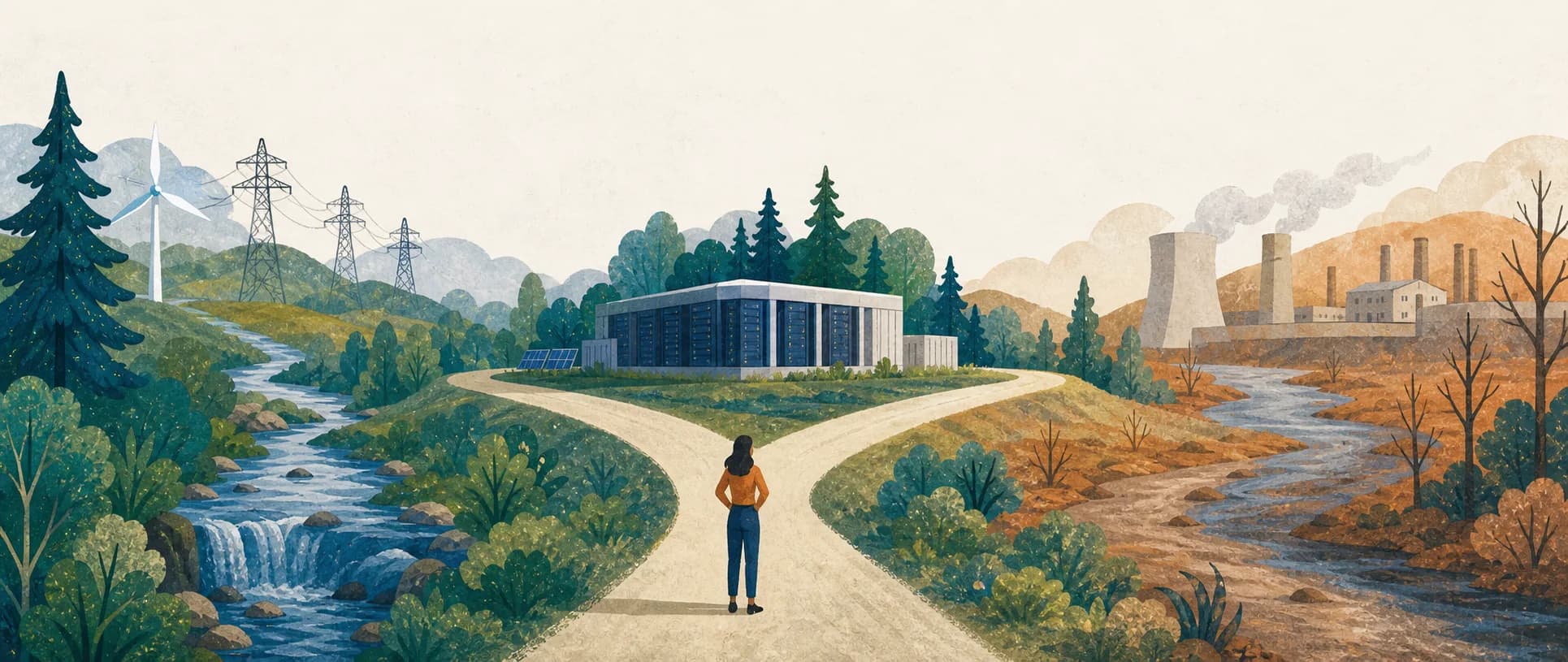
AI data centres can be bad for the environment because they concentrate large electricity demand, may consume water for cooling, and require land, buildings and specialised hardware. The harm is not identical everywhere. A well-utilised facility on a cleaner grid with low-water cooling has a different footprint from one adding fossil generation or competing for water in a stressed catchment.
Nor is every data-centre load AI. Streaming, storage, business software and conventional cloud services share the same infrastructure. The honest judgement asks what the facility consumes, where resources come from, which communities bear the effects, and whether the computing produces enough value to justify them.
Why AI changes data-centre demand
AI training and inference use accelerators such as GPUs and purpose-built chips. Dense racks of these processors can draw much more power than conventional server racks and release correspondingly more heat. That creates requirements for grid connections, cooling and backup systems.
The International Energy Agency says a conventional data centre may have 10–25 megawatts of capacity, while an AI-focused hyperscale facility can reach 100 MW or more. These are illustrative facility capacities, not universal consumption figures.
Globally, the IEA estimates all data centres consumed about 415 TWh in 2024. Its base case reaches about 945 TWh by 2030, with accelerated servers driven mainly by AI responsible for almost half the net increase. Forecast uncertainty is substantial, so the report includes higher- and lower-demand cases.
Grid effects are global and intensely local
At a world level, data centres accounted for around 1.5% of electricity in 2024, according to the IEA. At a local level, several large projects can dominate new demand. Their continuous, concentrated load may require transmission, substations and generation that take longer to build than the facilities.
What supplies that demand determines much of the carbon impact. The IEA expects renewables to meet nearly half of global growth in data-centre electricity supply to 2030 in its base case. Natural gas and coal together still meet more than 40% of the addition. Both the clean-energy investment and fossil growth are part of the picture.
Power purchase agreements can help finance renewable projects. Their quality depends on whether generation is additional, nearby and matched to demand in time. An annual certificate does not prove that every hour of operation was physically carbon-free.
Cooling can shift the burden to water
Processors turn electricity into heat. Facilities remove it with combinations of air, chilled water, evaporative systems and liquid delivered close to chips. Evaporation can reduce cooling electricity, but consumes water; dry cooling can reduce on-site water while sometimes raising energy demand.
Berkeley Lab’s 2024 US report modelled average site water-use effectiveness at just over 0.36 litres per kWh in 2023. The value is an estimated national average across different designs, not the rate for every data centre.
Electricity has an indirect water footprint as well. A facility advertised as using no water for cooling may still rely on generation that consumes water. For the full distinction between withdrawal, consumption and indirect use, see why data centres use water.
Buildings and chips matter beyond operation
A new campus contains concrete, steel, cables, batteries, generators and miles of equipment. Chip production uses energy, chemicals and ultrapure water. Mining and refining supply the metals. Those embodied effects happen before a model answers its first question.
They rarely appear in prompt-level figures. Allocating a building or processor across its many workloads requires assumptions about lifetime and utilisation. Higher utilisation can lower embodied impact per job, while rapid replacement can increase the total even when new hardware is more operationally efficient.
This is why a complete environmental assessment needs separate operational and embodied accounts. A low power usage effectiveness value describes facility energy overhead. It does not certify that hardware, water, land or electricity supply are sustainable.
Communities need more than global averages
National demand can be manageable while a proposed facility creates serious local trade-offs. Residents may reasonably ask who pays for grid upgrades, whether backup generators affect air quality, how much water is consumed during drought and how many lasting jobs a project creates.
Good siting considers cumulative demand from nearby facilities rather than permitting each in isolation. Reporting should use catchment-level water stress and hourly electricity data where possible. Operators should publish actual consumption after opening, not only design efficiency or future replenishment promises.
Water replenishment can fund useful watershed projects, but a global volume is not automatically equivalent to consumption in a particular place and season. Likewise, purchasing renewable electricity elsewhere does not remove every local grid constraint. Geography is part of environmental integrity.
How to judge an AI data centre
Ask for expected and actual annual electricity, peak demand, energy sources and hourly matching. Ask how much water is withdrawn and consumed, its quality, the source, seasonal peaks and local water stress. Check cooling design, projected hardware turnover and plans for reuse.
Then examine the service layer. Are high-capability models used only when needed? Are accelerators well utilised? Does the provider report absolute totals alongside efficiency? How AI affects the environment depends on these operational decisions, not simply the building’s label.
For individual use, choose proportionate models and avoid wasteful generation. Treechat publishes its model-based receipt assumptions on its methodology page. Those estimates cannot reveal a provider’s facility-specific water or power and do not claim to. Transparent limits are preferable to a precise green score unsupported by operational data.
AI data centres are not inherently good or bad buildings. They are consequential industrial infrastructure. The more useful conclusion from asking what AI is doing to the environment is that where and how this infrastructure expands will shape whether AI demand accelerates clean grids and efficient cooling—or deepens existing pressures.