How does AI affect the environment?
AI affects electricity, carbon, water and material use across its life cycle. Learn where the impacts occur and how to judge them.
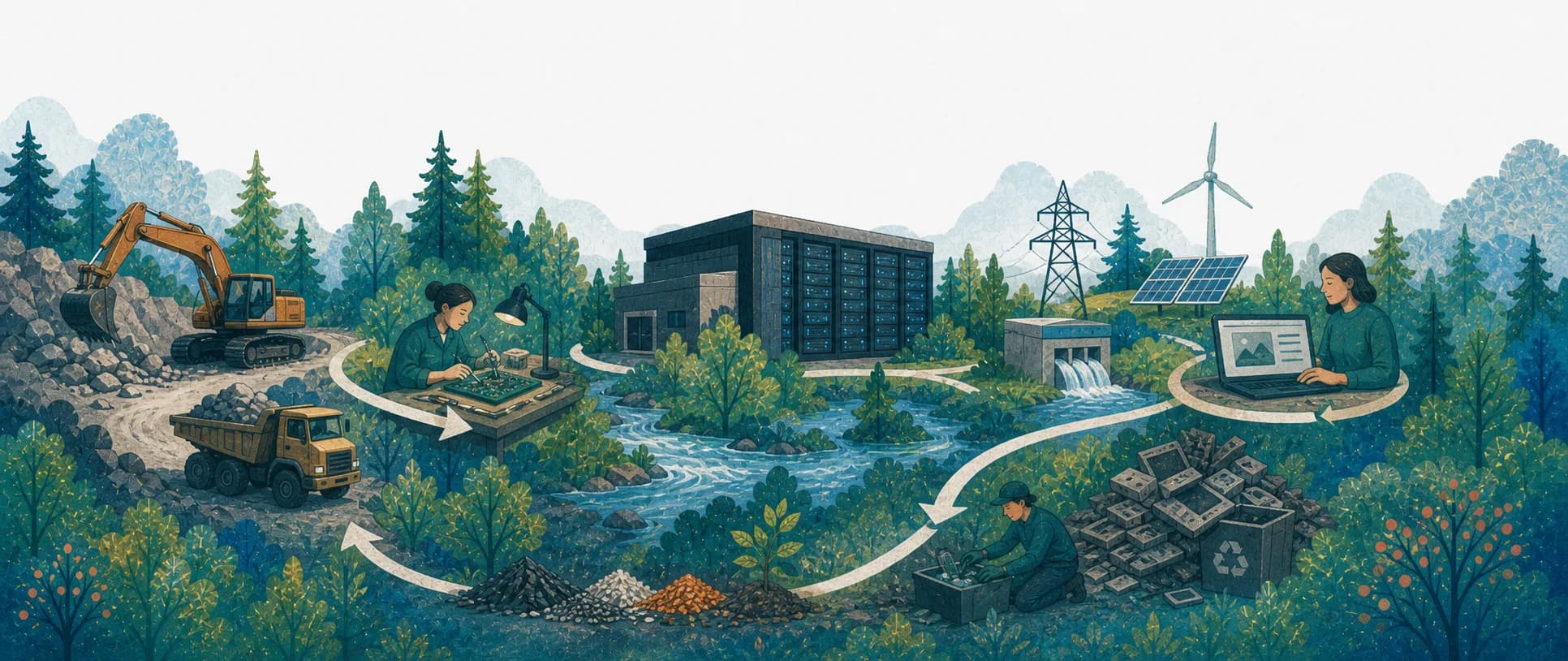
AI affects the environment through the computers, data centres and supply chains that make it work. Training and running models use electricity. Cooling can consume water. Manufacturing chips and constructing facilities require materials, water and energy. The resulting carbon emissions depend heavily on how the electricity is generated.
AI can also reduce environmental harm—for example by forecasting renewable power or spotting methane leaks—but those benefits are specific outcomes, not a free pass for every AI application. The size of the footprint changes dramatically with the model, task, response length, hardware, location and number of users. Any answer that assigns one fixed environmental cost to “AI” is leaving out important context.
The impact starts with hardware
Before a model is trained, its processors have to be made. Semiconductor fabrication is an energy- and water-intensive industrial process involving ultrapure water, chemicals and complex global supply chains. Servers also need memory, storage, networking and power equipment. Buildings add concrete, steel and cooling systems.
These embodied impacts are real but difficult to express per prompt. A processor can train several models and serve many other workloads over years. Dividing its manufacturing footprint by an assumed number of answers requires uncertain choices about utilisation and lifetime.
That is why most published “per query” figures cover operational electricity rather than the complete life cycle. Such a number can still be useful if the boundary is explicit. It becomes misleading when presented as the entire impact. A sound assessment separates manufacturing and construction from the energy used while training or serving a model.
Training and inference are different jobs
Training adjusts a model using large datasets and many repeated calculations. It may occupy clusters of accelerators for weeks or months. Inference happens after training whenever somebody asks the model to classify, predict or generate something.
Training is concentrated and easier to notice, but popular services can accumulate far more inference over their operating life. There is no fixed rule about which is larger: the balance depends on training runs, model lifetime, daily traffic and the work done per request.
Generative tasks also differ. Producing a short sentence, analysing a long document and generating video are not comparable. The study Power Hungry Processing measured 1,000 inferences across representative tasks and found generative, general-purpose systems markedly more energy-intensive than task-specific alternatives. It does not provide a universal rate, but it supports a practical lesson: use specialised or smaller systems when they can do the job.
Data centres turn computation into local demand
Servers draw electricity and release almost all of it as heat. Data centres must move that heat away while maintaining reliable power, networking and storage. Cooling, power conversion and other supporting equipment add overhead beyond the processors themselves.
The IEA estimates all data centres used about 415 TWh in 2024, or around 1.5% of global electricity. Its base case rises to about 945 TWh in 2030, with accelerated servers associated mainly with AI responsible for nearly half the net growth. These totals also include non-AI workloads, so they must not be relabelled as “AI electricity”.
Global shares can hide local strain. Facilities cluster where land, networks and grid connections are available. A new high-density campus may materially affect one region’s power planning even while data centres remain a modest share of worldwide demand. Our overview of AI data-centre impacts looks at that local context.
Electricity creates carbon, but not at one rate
The operational carbon footprint is energy multiplied by the emissions intensity of its electricity. That intensity varies by country, region and hour. Cleaner grids reduce it; fossil-heavy grids increase it.
Renewable procurement complicates the picture. A company may sign contracts that add clean generation or buy certificates matching its annual consumption. That can be valuable, but it is different from proving a server was supplied by carbon-free electricity at every moment. Both location-based and market-based reporting can be legitimate when clearly labelled.
The IEA expects renewables to meet nearly half of growth in data-centre electricity supply to 2030 in its base case. It also expects natural gas and coal together to meet more than 40% of the additional supply over that period. This mixed outlook is why “AI runs on renewables” and “AI runs on fossil fuels” can each select a true fragment while missing the system.
Water use has two layers
Data centres may consume water directly when cooling systems evaporate it to reject heat. They can also have an indirect water footprint because some power stations consume water when generating electricity. A facility using dry cooling may lower on-site consumption while using more electricity, creating a trade-off rather than a free reduction.
Berkeley Lab’s US data-centre report models cooling designs, electricity and future scenarios. Its results vary by facility type and show why a national average cannot describe a particular site.
Weather matters too. Cooling may consume more water on a hot day, while the electricity mix changes by hour. Water scarcity makes a litre in a dry basin more consequential than a litre in a water-abundant region. The question “how does AI use water?” therefore needs location and timing, not just a global volume.
AI’s environmental benefits need a counterfactual
AI is used in weather forecasting, electricity-demand prediction, renewable integration, industrial controls and leak detection. The IEA catalogues ways those applications could improve energy systems. There are also costs: sensors, networks, models and changes in behaviour.
To decide whether an application helps, compare it with what would otherwise happen. Measure the avoided energy, emissions or waste, subtract the system’s footprint and monitor results after deployment. Do not count a laboratory possibility as an achieved saving.
Rebound effects deserve attention. Efficiency can make an activity cheaper and encourage more of it. An optimisation that cuts energy per job may still accompany higher total consumption. This does not make efficiency pointless; it means per-unit and total effects should be reported together. Read whether AI can be good for the environment as an evidence question, not a label.
How to reduce the impact of your use
Use the least computationally demanding tool that reliably solves the task. A calculator, search result or local rule may beat a general model. For AI work, prefer a small capable model; keep documents and conversation history focused; avoid unnecessary regeneration; and reserve images, video and long reasoning for cases that warrant them.
Ask providers for boundaries and uncertainty. Does a figure include only accelerator electricity, the whole data centre, water, embodied hardware or training? Is it measured, modelled or averaged? Our methodology says Treechat’s per-message receipts are model-based operational estimates. They are not direct measurements or full life-cycle claims.
The environmental effect of AI is ultimately a system question. Individual choices influence demand, while providers determine model architecture, hardware utilisation, facility location and disclosure. Policy shapes electricity supply, water permitting and reporting. Better decisions require all three levels—and a refusal to turn incomplete numbers into certainty.