Why do data centres use water?
Data centres use water mainly to remove server heat, and indirectly through electricity. Learn how cooling systems change the trade-offs.
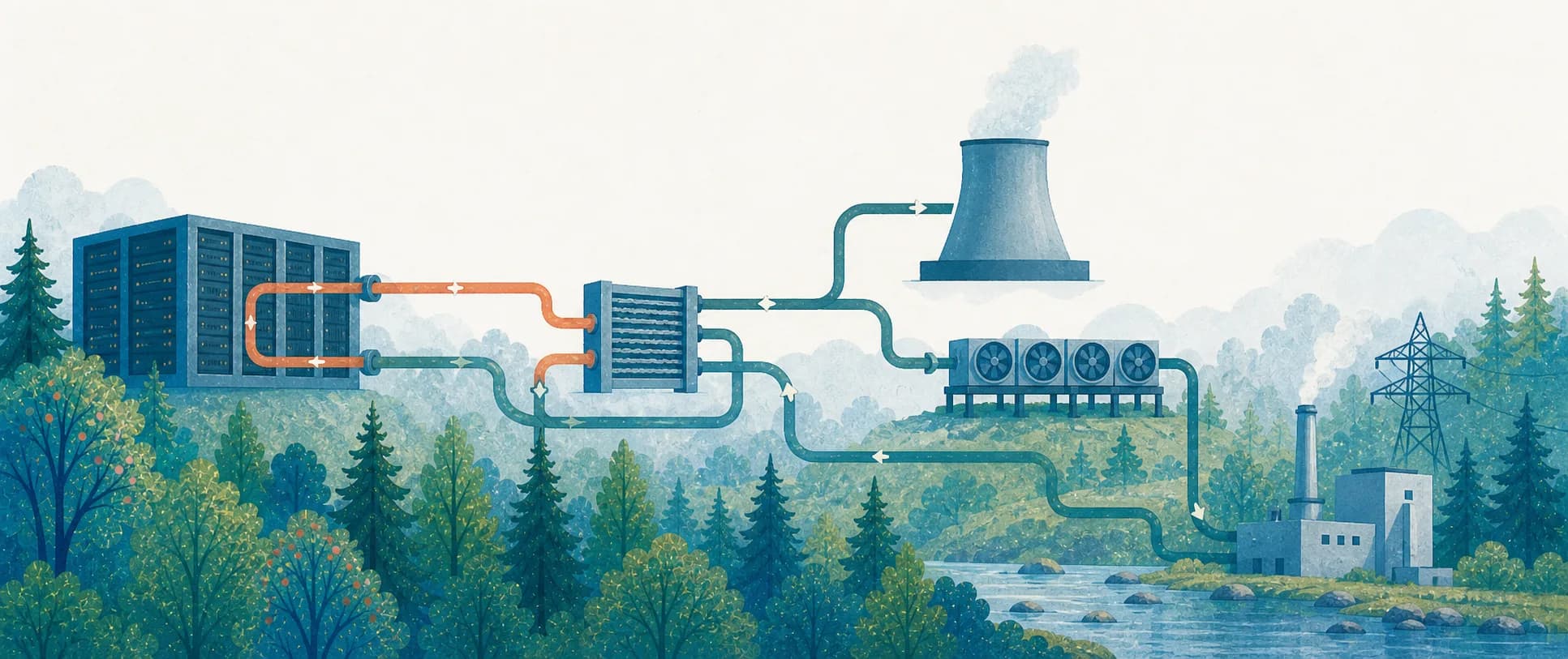
Data centres use water mainly to remove heat from servers. Evaporating water is an effective way to carry heat out of a building, so many cooling systems use cooling towers or similar equipment. Data centres can also have an indirect water footprint because some power stations consume water while generating their electricity.
Not every facility uses the same amount. Some rely on outside air, dry coolers or closed-loop liquid systems that consume little water on-site. Climate, server density and grid supply shape the choice. “Liquid cooling” does not necessarily mean high consumption, and “zero water for cooling” does not mean zero water across electricity, offices and chip manufacture.
Computing creates a continuous heat problem
Processors use electricity to switch billions of electronic components. Nearly all that electrical energy ends up as heat. A data centre must remove it continuously to keep chips within safe temperatures and prevent performance loss or failure.
Conventional facilities can move cool air through server rooms. Dense AI racks make that harder because many high-power accelerators sit close together. Liquid carries heat more effectively than air, so operators increasingly bring coolant to a cold plate near the chip or immerse equipment in a fluid.
The internal loop can stay sealed. The crucial water question comes at the final stage: how does the facility release heat to the outside air? A cooling tower may evaporate water; a dry cooler uses fans and heat exchangers; hybrid systems switch methods with weather.
Evaporation trades water for energy efficiency
Water absorbs heat when it evaporates. In suitable conditions, evaporative cooling can use less electricity than compressors and fans in a fully dry system. The trade-off is that evaporated water leaves the local liquid supply and must be replaced.
Cooling towers also discharge some water to control mineral build-up. Operators can improve cycles of concentration, treat water or use reclaimed sources, but water chemistry and equipment limits matter. A simple “litres in” figure may combine evaporation and discharge even though their destinations differ.
Dry cooling reduces on-site consumption, but can lose efficiency during hot weather. Extra electricity may raise carbon and indirect water use depending on the grid. Good engineering assesses the whole local system rather than assuming one technology wins everywhere.
Electricity can use water off-site
Thermal power stations—including many coal, gas and nuclear plants—often use water in steam cycles and cooling. Withdrawal and consumption vary with plant type and cooling design. Wind and solar photovoltaic generation generally have low operational water consumption, while reservoir hydropower raises difficult allocation questions around evaporation.
This indirect use means a facility can avoid evaporation on-site while retaining a water footprint through the grid. It may occur in a different catchment, which matters for both accounting and local policy.
Berkeley Lab’s US data-centre report models direct site consumption and indirect electricity-related consumption separately. Keeping the layers visible helps answer two questions: what pressure does the data centre place on its local water system, and what broader water demand follows from its power?
Water metrics need careful reading
Water withdrawal is the volume taken from a source. Water consumption is the portion not returned promptly to the same source, usually because it evaporates. Water-use effectiveness commonly expresses site water consumption per unit of IT electricity.
Berkeley Lab modelled the average across US data centres at just over 0.36 litres per kWh in 2023. It is an estimated national fleet average, not a design target or a rate that can be safely assigned to one company.
Absolute litres matter alongside efficiency. A facility can improve litres per kWh while total water rises because computing grows. Source, quality, season and catchment stress also determine consequence. Reclaimed water may reduce competition for drinking supply, though it still has treatment and ecological trade-offs.
AI changes density more than the basic physics
Data centres used water before modern generative AI. AI changes the scale and concentration of the heat. Accelerators in dense racks can require new cooling distribution, and expanding workloads increase both power and cooling demand.
That does not justify labelling every data-centre litre as AI water. Facilities serve storage, video, enterprise software and other cloud workloads. Allocation needs workload and energy data that operators rarely publish.
Per-query water figures therefore rely on models. They combine estimated computation with cooling and grid assumptions. Our explanation of AI water usage per query shows why reputable estimates span fractions to tens of millilitres for ordinary text.
Better cooling starts with better siting
Operators can choose efficient hardware, raise safe operating temperatures, use outside air, optimise controls and use reclaimed water. Closed-loop systems can avoid evaporation, as can dry cooling where climate and grid conditions support it. Waste heat can sometimes serve nearby buildings or industry, although matching temperature, distance and demand is not trivial.
Siting remains fundamental. A water-efficient design in a stressed basin may still be less responsible than one placed where resources and infrastructure are better matched. Communities need expected peak and annual consumption, cumulative nearby demand and actual reporting after launch.
Corporate replenishment can support watersheds, but should be disclosed separately from on-site use. Volume, location, timing, additionality and water quality determine whether a project addresses the original pressure.
What a user can take from this
Avoid the image of a server literally drinking with each prompt. Water belongs to shared cooling and electricity systems, then gets allocated to workloads. The allocation is useful when its assumptions remain attached.
Reduce needless computation by choosing smaller capable models, keeping context focused and avoiding disposable outputs. For provider claims, ask whether water is direct or indirect, withdrawn or consumed, measured or modelled. The broader guide to how AI uses water covers manufacturing as well.
Treechat derives its water receipt from estimated message energy using a disclosed constant on the methodology page. It is not a reading from a cooling tower. The method is intentionally visible because, until providers offer facility- and workload-specific data, honest estimates need to show their limits.