What is AI doing to the environment right now?
AI is increasing data-centre demand while enabling some environmental tools. Here is the current evidence, without treating forecasts as facts.
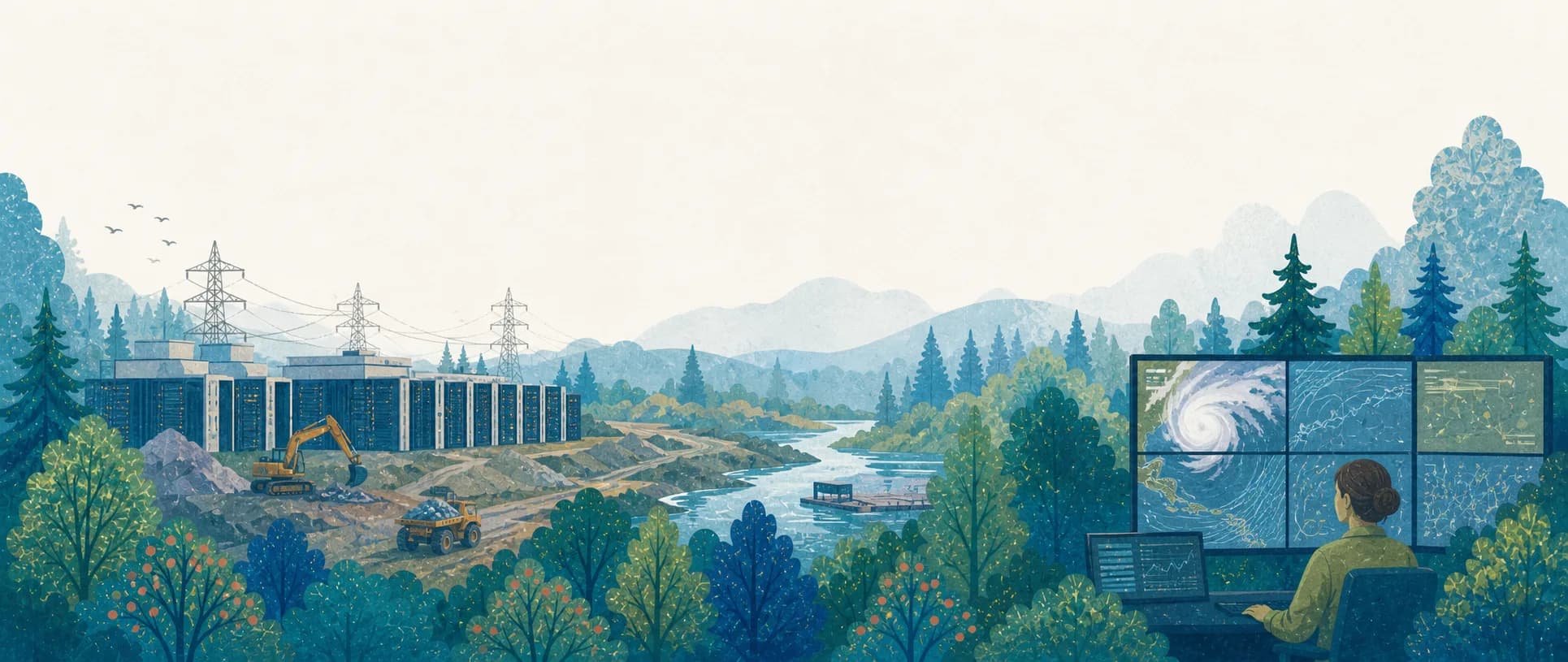
AI is increasing demand for data centres, specialised chips, electricity and cooling. That expansion can raise carbon emissions, consume water and add pressure to local grids and supply chains. At the same time, AI is being used to forecast renewable power, detect leaks and optimise energy systems. The costs are certain; the scale of future demand and the net benefit of many applications remain uncertain.
Current public data usually measures entire data centres or company operations, not AI alone. That makes it possible to describe the direction confidently but not to assign every change to AI. Claims that AI is either an environmental catastrophe already or an automatic climate solution run ahead of the evidence.
Data-centre electricity is rising
The International Energy Agency estimates data centres used about 415 terawatt-hours in 2024, around 1.5% of world electricity. This includes storage, streaming, enterprise computing and other services as well as AI.
In its base case, the IEA projects about 945 TWh by 2030. Accelerated servers, driven mainly by AI adoption, account for almost half the net increase. Its high-efficiency and slower-growth cases are lower; a rapid AI expansion case is higher. The range is important because no one knows future uptake, chip efficiency or infrastructure constraints precisely.
The immediate effect is uneven. Data centres concentrate in particular regions, so new demand can be a major grid-planning issue locally even while the global percentage looks modest.
New demand has a mixed power supply
The carbon result depends on which generators respond. The IEA’s base case expects renewables to meet nearly half the growth in electricity supplied to data centres between 2024 and 2030. Natural gas and coal together provide more than 40% of the additional supply over the same period.
That means AI-linked investment can support clean-energy contracts while also extending fossil generation. The proportions vary by region: grids, construction timelines and policy differ. An annual renewable purchase does not always mean demand and clean supply match in the same place and hour.
The IEA projects electricity-related data-centre emissions peaking around 320 million tonnes of CO2 in 2030 in its base case. It remains less than 1% of global CO2, but is rising while many sectors need to decline. Read AI’s environmental impact explained for the difference between energy and carbon.
Water demand is becoming more visible
AI hardware creates dense heat. Many facilities use evaporative cooling, which consumes water, though the design and rate vary. Electricity generation can add indirect consumption beyond the site boundary.
Berkeley Lab modelled US data-centre site water-use effectiveness at a little over 0.36 litres per kWh in 2023. It projects changes as liquid cooling and facility types evolve. These are modelled national averages, not readings from every operator.
Some companies are introducing closed-loop designs that avoid evaporating water for cooling. That can reduce local consumption, but “zero water cooling” is not the same as zero water across electricity and chip manufacture. Our guide to how AI uses water separates these layers.
Chip production and construction are expanding
More computing requires accelerators, memory, networking, power equipment and buildings. Their supply chains use metals, chemicals, energy and water. Concrete and steel add embodied emissions; semiconductor fabrication needs ultrapure water; old hardware becomes an electronic-waste and reuse question.
This footprint is harder to observe than a facility’s electricity bill. Company sustainability reports often provide total supply-chain emissions, but isolating the share caused by AI requires allocation assumptions. Rapid infrastructure expansion is one reason operational efficiency alone cannot describe the whole trend.
Longer hardware life, high utilisation, component reuse and lower-carbon materials can reduce impact per unit of work. They should be reported alongside absolute procurement and construction, because an efficient new generation of chips can still accompany a larger total hardware footprint.
Environmental uses are moving beyond demos
AI is already used for weather prediction, power forecasting, equipment maintenance and detecting methane leaks. The IEA reviews a range of applications that can reduce fuel use, losses and downtime.
The net effect is not automatic. A model needs data, hardware and integration, and it must change a real decision. Benefits should be compared with conventional software or operational improvements and measured after deployment. Scaling can also cause rebound if lower costs encourage more activity.
So it is reasonable to say AI can help the environment, but not to add every theoretical saving to one side of a ledger while ignoring infrastructure on the other. Our article is AI good for the environment? offers a test based on counterfactuals and observed outcomes.
What to watch over the next few years
The most revealing indicators will be absolute electricity demand, the generation built to serve it, water consumption in stressed catchments, and life-cycle reporting for chips and construction. Per-query efficiency matters, but volume can overwhelm it.
Watch for workload-specific disclosure. “Cloud” totals blur AI and non-AI services; model-level estimates omit buildings and idle capacity. Both have value if clearly bounded. Policy on grid connections, water permits and emissions reporting will shape what operators must reveal.
At user level, prefer the smallest model that completes the work and avoid needless long context or media generation. Treechat’s receipts follow a model-based methodology; they are estimates, not live facility measurements. The wider answer to how bad AI really is will depend less on one prompt than on the infrastructure and norms now being chosen.