AI's impact on the environment, explained clearly
A clear guide to AI's energy, carbon, water and hardware footprint—and the boundaries behind the numbers you see.
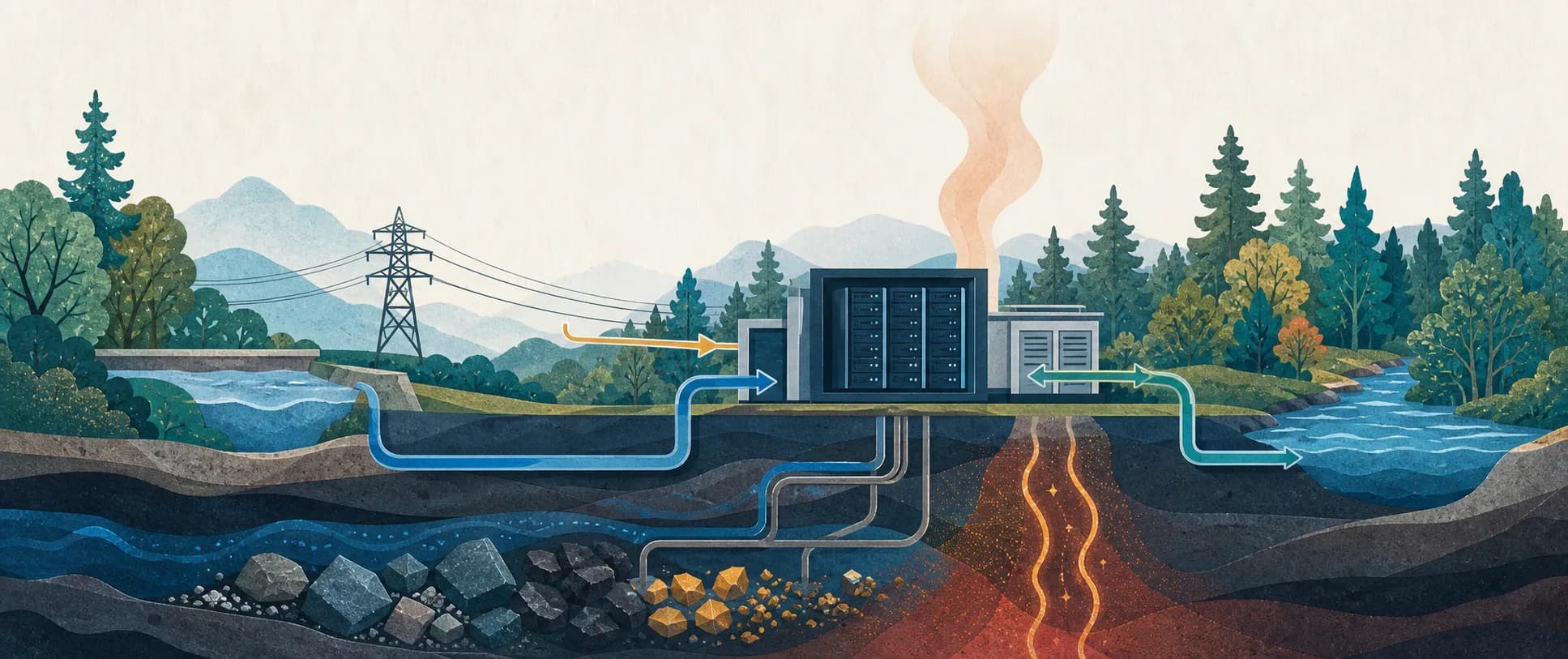
AI’s environmental impact comes from four connected sources: electricity used for computation, carbon and water associated with that electricity, water used directly for cooling, and the materials and manufacturing behind chips and data centres. The total depends on what the AI does, how large the model is, how efficiently hardware is used, and where it runs.
There is no trustworthy universal footprint for an AI query. A short response from a small model is a different workload from frontier-model research or generated video. Most public figures are estimates with different boundaries. The useful question is therefore not “what is AI’s number?” but “which impact, for which system, measured or modelled in what way?”
Start by drawing the boundary
An environmental number only makes sense after deciding what it includes. A narrow inference estimate might cover accelerator electricity while an answer is generated. A broader operational estimate adds memory, networking, cooling and power conversion. A life-cycle estimate may also allocate training, chip manufacture, construction and disposal.
None is automatically wrong. Each answers a different question. Trouble starts when a narrow number is described as a complete footprint or compared with a broad one.
Treechat’s methodology, for example, estimates operational energy from the chosen model and token counts, then adds data-centre overhead and an average grid carbon factor. It is not a power meter and does not claim to capture manufacturing. That limitation belongs beside the result, not hidden in small print.
Computation becomes electricity and heat
Models run mathematical operations on processors. Training repeats them while adjusting model weights; inference uses the trained weights to produce an answer. Both draw electricity, and almost all of that energy ultimately becomes heat that must be removed.
Task type matters. Luccioni, Jernite and Strubell measured energy across machine-learning workloads and found general-purpose generative models used substantially more energy than task-specific models for comparable tasks in their benchmark. The exact results belong to their tested hardware, datasets and models, but the direction is instructive.
Tokens, context and output length matter within text generation. Image and video generation usually involve different, heavier computation. Efficient batching and newer accelerators can reduce energy per result, while lightly used servers and repeated generations can raise it.
Data-centre totals show scale, not one answer
The IEA reports that data centres consumed about 415 TWh in 2024, around 1.5% of global electricity. Its base case projects roughly 945 TWh in 2030. AI is the leading driver of that increase, but the totals include cloud storage, streaming, enterprise software and other non-AI services.
This distinction prevents two common errors. Calling the entire total “AI use” exaggerates AI’s current share. Looking only at a tiny per-prompt average can understate the infrastructure being built for rapidly expanding workloads.
Forecasts are also conditional. The IEA models different paths because demand, hardware efficiency and grid constraints are uncertain. Projections should guide planning, not be repeated as inevitable facts. For a more direct judgement, see is AI bad for the environment?.
Carbon follows the energy supply
The same amount of computation can have different operational emissions in different places and hours. Fossil generation raises the carbon intensity; low-carbon generation lowers it. Data-centre efficiency affects how much supporting electricity is needed around the chips.
The IEA’s base case expects renewables to supply nearly half of added data-centre electricity through 2030, but natural gas and coal together supply more than 40%. Its model has electricity-related data-centre emissions reaching about 320 million tonnes of CO2 around 2030 before declining slightly. That is a data-centre estimate, not an AI-only inventory.
Annual renewable matching can finance cleaner capacity and reduce market-based emissions. It does not necessarily describe the physical grid at the instant a request runs. Better disclosure presents both the contractual claim and the local, time-sensitive reality.
Water can be direct or indirect
Evaporative cooling can use water efficiently from an electricity perspective because evaporation carries away heat. The water consumed is not returned immediately to the same catchment. Dry or closed-loop systems can greatly reduce on-site consumption, sometimes at the cost of extra energy or equipment.
Power generation adds indirect water use. That means “zero water for cooling” does not necessarily mean a zero-water service. Conversely, a renewable-heavy grid may lower both indirect water consumption and carbon, depending on the technologies involved.
Per-query water estimates differ by orders of magnitude because researchers and operators model different services, places and boundaries. A bottle-per-message claim is not supported by the original study behind the popular comparison. Our AI water-use guide separates those figures and explains what each can—and cannot—say.
Materials make the footprint longer-lived
Accelerators, servers and buildings carry embodied impacts from mining, refining, manufacturing and transport. Semiconductor plants need water and chemicals; data centres need concrete, steel, batteries and backup generators. Replacing hardware quickly can increase these impacts even if each new chip is more efficient in operation.
They are rarely included in consumer-facing query estimates because allocation is hard. How much of a factory’s footprint belongs to one processor? How should that processor be divided among training runs and billions of inferences? What lifetime and utilisation should be assumed?
These unanswered questions do not justify ignoring hardware. They justify reporting it separately and improving supplier disclosure. A rounded operational receipt can support day-to-day choices; procurement and policy need life-cycle evidence as well.
Turn the explanation into better decisions
For users, the strongest practical lever is proportionality. Use search, a calculator or existing software when they suffice. Choose a smaller or specialised model for routine work. Limit irrelevant context, ask for the length you need and avoid batches of disposable outputs.
For organisations, measure workload volume as well as per-use efficiency. Ask vendors about model choice, facility energy, water stress, hardware life and the accounting behind renewable claims. Evaluate claimed benefits against a real baseline. Our guide to what AI is doing to the environment covers the system-level direction; the generative-AI guide focuses on the most resource-intensive consumer uses.
Treechat routes ordinary questions towards smaller models and labels its result as an estimate. Every paid member also funds one newly planted tree each month, but planting is not treated as proof that computation had no impact. Reduction, transparent estimation and a separate climate contribution answer different parts of the problem.