How does AI use water? A complete explanation
AI uses water for data-centre cooling, electricity generation and chip production. Learn what per-query estimates include and miss.
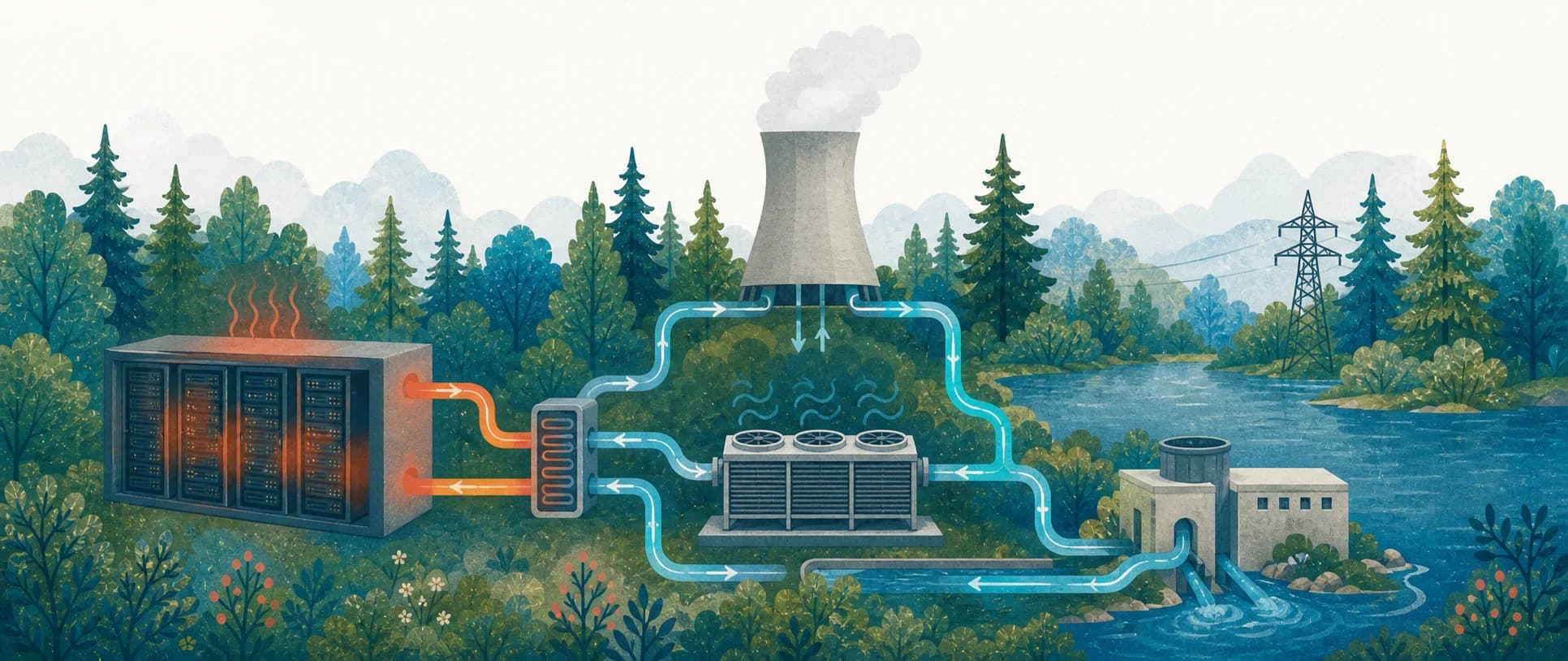
AI uses water in three main ways. Data centres may evaporate water to remove heat from servers. The power stations supplying their electricity may consume water. Manufacturing semiconductors also requires large amounts of highly purified water. A text prompt does not literally send water through a computer; it creates computing work that receives a share of these larger systems.
There is no universal amount per AI query. Cooling design, weather, location, electricity mix, model, hardware and response length all change the result. Public estimates also draw different boundaries. Some count only on-site cooling, while others add water associated with electricity. The fairest answer is therefore a range tied to a named system and method, not one bottle-sized fact for every message.
Servers turn electricity into heat
AI calculations run on processors in racks. Nearly all the electricity they use becomes heat. If that heat is not removed, chips slow down or fail, so a data centre needs a continuous cooling system.
Some facilities use outside air when weather permits. Others circulate chilled water inside a closed loop, move heat to a cooling tower, and evaporate water into the atmosphere. Direct-to-chip liquid cooling can carry heat efficiently from dense AI racks, but the final heat-rejection system determines whether water is consumed on-site.
Water circulating in a sealed loop is not necessarily used up. Consumption occurs mainly when water evaporates or leaves the usable local supply. This is why “liquid-cooled” and “water-consuming” are not synonyms. To understand the engineering choices, start with why data centres use water.
Withdrawal and consumption are different
Water withdrawal is the volume taken from a river, aquifer or utility. Consumption is the portion not promptly returned to the same source, commonly because it evaporates. A once-through cooling system can withdraw a large volume and return much of it warmer; an evaporative system may withdraw less but consume a larger share.
Both measures matter. High withdrawal can affect ecosystems and infrastructure. Consumption can reduce water available to other users. Water quality, source and season add context: potable water, reclaimed wastewater and harvested rainwater are not interchangeable.
Global litres also hide scarcity. One litre consumed in a wet season and water-abundant basin is not equivalent to one litre during drought. Good reporting gives facility location, catchment stress, source, withdrawal and consumption rather than collapsing them into a single corporate total.
Electricity adds an indirect water footprint
Power plants can use water for steam cycles and cooling. The rate varies across coal, gas, nuclear, hydro, wind and solar technologies, and by cooling system. A data centre with little on-site water use can therefore retain an indirect footprint through its electricity.
Berkeley Lab’s 2024 United States Data Center Energy Usage Report models direct site water and water consumed in electricity generation separately. That is an important boundary choice. Adding them can be appropriate for a broad footprint, while reporting on-site use alone answers a local permitting question.
Dry cooling may lower direct consumption but require more electricity, especially in hot conditions. If that extra power comes from water- or carbon-intensive generation, the system has shifted impact rather than simply removed it. There is no universally best cooling technology independent of climate and grid.
Where per-query numbers come from
In 2023, researchers Shaolei Ren, Pengfei Li and colleagues modelled operational water for language models in Making AI Less “Thirsty”. Their estimate suggested a 500 ml bottle could correspond to roughly 20–50 medium-length responses, depending on when and where GPT-3-class services ran. That implies about 10–25 ml per response under their assumptions; it was not a direct measurement of ChatGPT plumbing.
Later provider disclosures were far lower. Sam Altman stated an average ChatGPT query used about 0.000085 US gallons, roughly 0.32 ml. Google measured 0.26 ml for a median Gemini Apps text prompt in May 2025.
These figures describe different models, fleets, times and methodologies. Google’s result is a point-in-time median for its service; the academic work estimates direct and indirect water under scenarios; Altman published an average without a full calculation. The disagreement is evidence that boundary and infrastructure dominate the answer.
A query does not have a fixed allocation
A provider might divide facility water by all workloads, estimate water from electricity, or allocate cooling based on server energy. Each requires choices about idle capacity, supporting equipment and what counts as an AI prompt. Long context and output also make queries unequal.
Training complicates allocation further. The “Less Thirsty” paper estimated that training GPT-3 in Microsoft’s US data centres could directly consume 700,000 litres of freshwater under its scenario. That is a modelled estimate for a particular training run, not a known total for every GPT model. Dividing it across future queries depends on an unknown lifetime and traffic.
Chip fabrication sits further upstream and is rarely included in prompt claims. A complete life-cycle assessment would allocate manufacturing water too, but public data is not detailed enough to do that confidently for most services.
Company totals help, with caveats
Operator sustainability reports reveal trends that prompt estimates cannot. They can show total company withdrawal, consumption and replenishment, and sometimes data-centre water-use effectiveness. Yet their boundaries cover many products, offices and facilities; they seldom isolate one model.
Replenishment is also separate from consumption. Funding watershed restoration or leak repair can produce real benefits, but a litre replenished elsewhere or years later is not physically the same litre consumed at a site. Quality, location, timing and whether the project would have happened anyway all matter.
Microsoft says new data-centre designs introduced from August 2024 avoid evaporating water for cooling. It explicitly notes that water remains for kitchens and toilets. Indirect electricity and manufacturing water also remain outside that “cooling” claim.
How to read a water claim
First ask whether the figure is withdrawal or consumption. Then ask whether it includes on-site cooling, electricity generation, training and chip manufacture. Look for the model, task length, location, period and whether the number was measured or estimated.
Be cautious with household comparisons. A bottle is easy to picture but can turn a scenario into a universal rate. Our article on AI water per query compares the principal estimates, while the ChatGPT water guide focuses on what is public for that service.
Treechat estimates water from estimated message energy using a fixed factor disclosed on its methodology page. It cannot see facility-level cooling or electricity generation, so the receipt is not a measured water allocation. Its value is consistency and visible uncertainty, not precision.
What users and organisations can do
Users can choose a smaller capable model, keep context and outputs proportionate, avoid unnecessary regenerations and reserve heavy media creation for useful results. These steps reduce computation, which usually reduces both heat and the water allocated to it.
Organisations have stronger levers. Ask providers for facility-level consumption in water-stressed regions, direct and indirect boundaries, seasonal peaks and workload-specific estimates. Prefer reclaimed water where appropriate, efficient hardware and siting that respects catchment limits. Track absolute use as well as litres per kWh.
Policy makers and communities can require transparent water permits, cumulative impact assessment and post-opening reporting. Efficiency alone cannot guarantee lower totals if demand grows faster. The aim is not to declare digital services waterless; it is to make their real, local trade-offs visible enough to manage.
Frequently asked questions
Does AI consume drinking water?
Sometimes. Facilities may use potable utility water, reclaimed wastewater or other sources depending on location and design. Company-wide reporting should identify source and quality; a global total usually does not tell you what one facility used.
Does every AI prompt use water?
Every prompt uses computation and electricity. Its allocated water can be near zero at a particular site and time if cooling and generation consume little water, but upstream manufacturing still has a footprint. There is no fixed physical sip attached to a prompt.
Is 500 ml per message accurate?
No. The widely cited study estimated 500 ml for roughly 20–50 responses under certain scenarios, not one. Newer provider figures for median or average text prompts are much lower, but use different boundaries.
Can a data centre use zero water?
It can avoid consuming water for on-site cooling. That does not prove zero water across offices, electricity generation, construction and chip manufacture. Always read the noun after “zero water”.