How much water does ChatGPT use?
Public estimates for ChatGPT range from fractions to tens of millilitres per query. Here is why they conflict and what each counts.
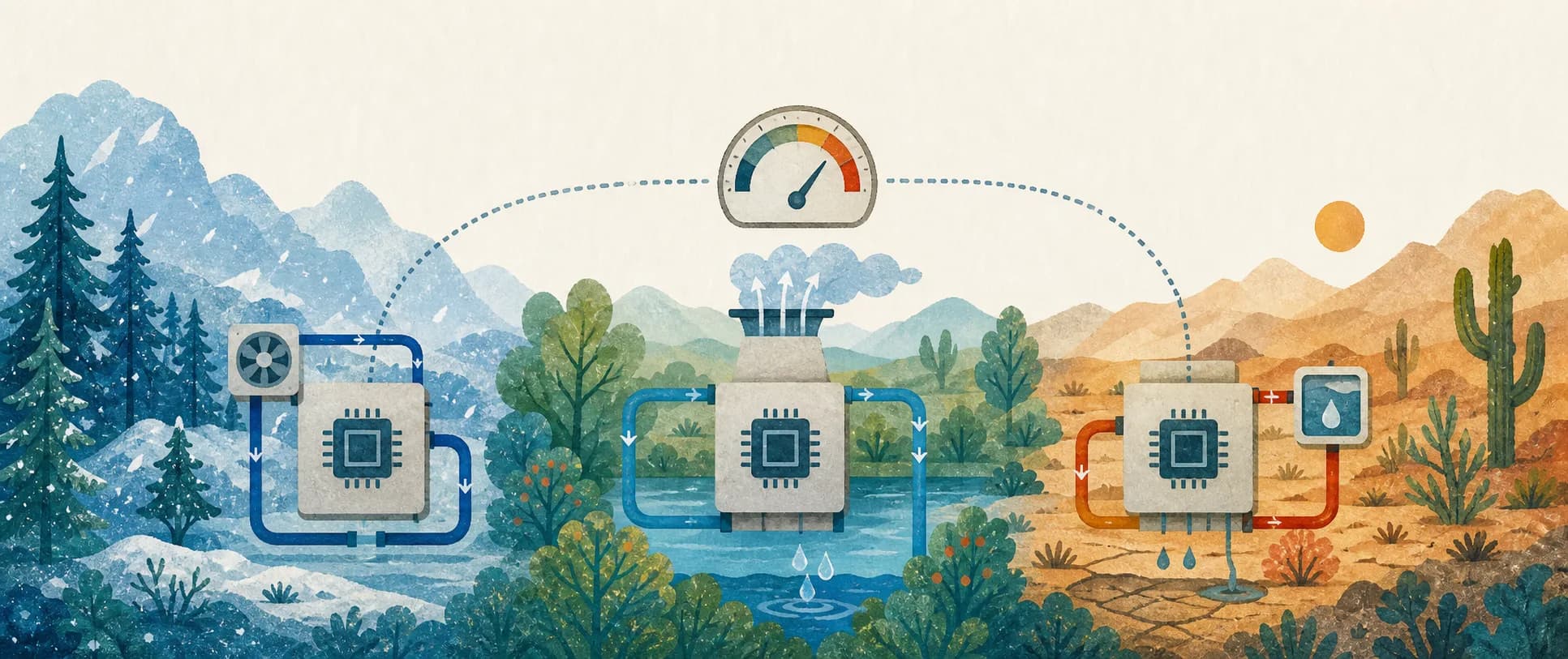
The only public first-party average says a ChatGPT query uses about 0.000085 US gallons of water—roughly 0.32 millilitres. OpenAI chief executive Sam Altman published that figure in 2025, but did not provide the calculation or define which models, locations and water boundaries it covers.
Independent research has produced much higher estimates. A 2023 paper suggested about 500 ml for 20–50 medium-length responses, or roughly 10–25 ml each, depending on where and when the system ran. These numbers are not directly comparable. The honest answer is that ChatGPT’s water use varies, and public disclosure is not detailed enough to calculate your exact conversation.
The first-party figure is an average
Altman’s published statement gave two operational averages for a ChatGPT query: about 0.34 Wh of electricity and 0.000085 US gallons of water. Converting the latter gives approximately 0.32 ml.
It is useful because it comes from the operator, which can observe its infrastructure and traffic. It is limited because the post does not disclose its measurement period, distribution of models, query length, direct-versus-indirect boundary or treatment of training.
An average can also hide a broad range. A short request and a long reasoning session are different computing jobs. Search, files, images and agent tools may invoke several systems. The figure is best treated as a fleet-level signpost for ordinary use, not a water meter attached to every ChatGPT message.
Why the academic estimate is higher
The 2023 paper Making AI Less “Thirsty” estimated both on-site cooling water and water associated with electricity. Its researchers modelled particular data-centre locations, weather and power grids rather than measuring OpenAI’s private fleet.
Their headline example was that a 500 ml bottle could serve roughly 20–50 responses. That equates to 10–25 ml per response under the paper’s assumptions. It never supported “one bottle per message”.
The modelled service, infrastructure assumptions and time differ from Altman’s later average. Hardware and cooling also improved. A boundary including indirect power-generation water will usually be broader than one focused on direct cooling. Without a matching methodology from OpenAI, we cannot isolate how much of the gap comes from efficiency and how much comes from accounting.
Water use changes with place and time
Evaporative cooling consumes water to move heat out of a data centre. The amount depends on temperature and humidity, cooling equipment and server load. A facility using outside air or closed-loop cooling may consume less on-site.
Electricity generation can consume water too. Its rate changes with the local mix of thermal power, wind, solar and other sources. Both the cooling demand and grid mix can vary hour by hour, so the same model request may have different allocated water in different regions.
Scarcity changes consequence as well as volume. A millilitre in a drought-affected catchment has different local significance from one in a water-abundant region. A global average cannot express that. See how AI uses water for direct, indirect and manufacturing stages.
Training and chips sit outside most query claims
The academic paper estimated that training GPT-3 in Microsoft’s US data centres could directly consume about 700,000 litres under its model. That is not a disclosed OpenAI measurement, and newer ChatGPT models have different training runs. It should not be presented as a known total for today’s product.
Sharing training water across queries is an accounting choice. The per-query allocation falls if a model serves more requests and rises if it is retired early. The water was consumed during training, not each time a user presses send.
Semiconductor manufacturing also uses ultrapure water, while data-centre construction has upstream impacts. Consumer prompt figures rarely include either because utilisation, hardware lifetime and supply-chain allocation are uncertain. A narrow operational estimate remains useful, but it is not a complete life-cycle total.
What the bottle comparison gets wrong
The phrase “ChatGPT drinks a bottle of water” makes a modelled allocation sound like a physical event. Servers do not open a bottle when a message arrives. Cooling systems operate across many workloads, and researchers apportion some of their consumption to a request.
The comparison also encourages a fixed rate. Even the original paper gave a 20–50 response range because location and time mattered. Later figures describe fractions of a millilitre. Choosing one endpoint without its source and boundary turns uncertainty into clickbait.
Our dedicated audit—does AI really use a bottle per message?—traces the claim. The conclusion is not that AI uses no water. It is that the unit, denominator and scope must travel with the number.
What can you do with this uncertainty?
Treat 0.32 ml as OpenAI’s stated average, not your exact measurement. Treat 10–25 ml as a research scenario for a different service boundary, not a current ChatGPT reading. Do not average them together: that would create a number supported by neither source.
For lower-impact use, keep conversations focused, avoid repeated attempts and use advanced reasoning or generated media when the task justifies it. Choosing a smaller suitable model can reduce computation and the cooling load allocated to the answer.
Providers hold the decisive data. They can publish distributions by model and task, direct and indirect water, facility locations and seasonal consumption. Until they do, responsible estimates should stay broad and explicit. Treechat follows that principle in its methodology: its water receipt derives from estimated energy and a fixed factor, not a live reading of a data centre.
For visual comparisons without losing the caveats, see AI water use versus everyday things. The key lesson is simple: the environmental issue is aggregate, local infrastructure—not a literal sip taken by your screen.