How verified tree planting works
Verified tree planting connects funding to a documented project and follows planting with monitoring. Certificates are evidence, not a guarantee of permanence.
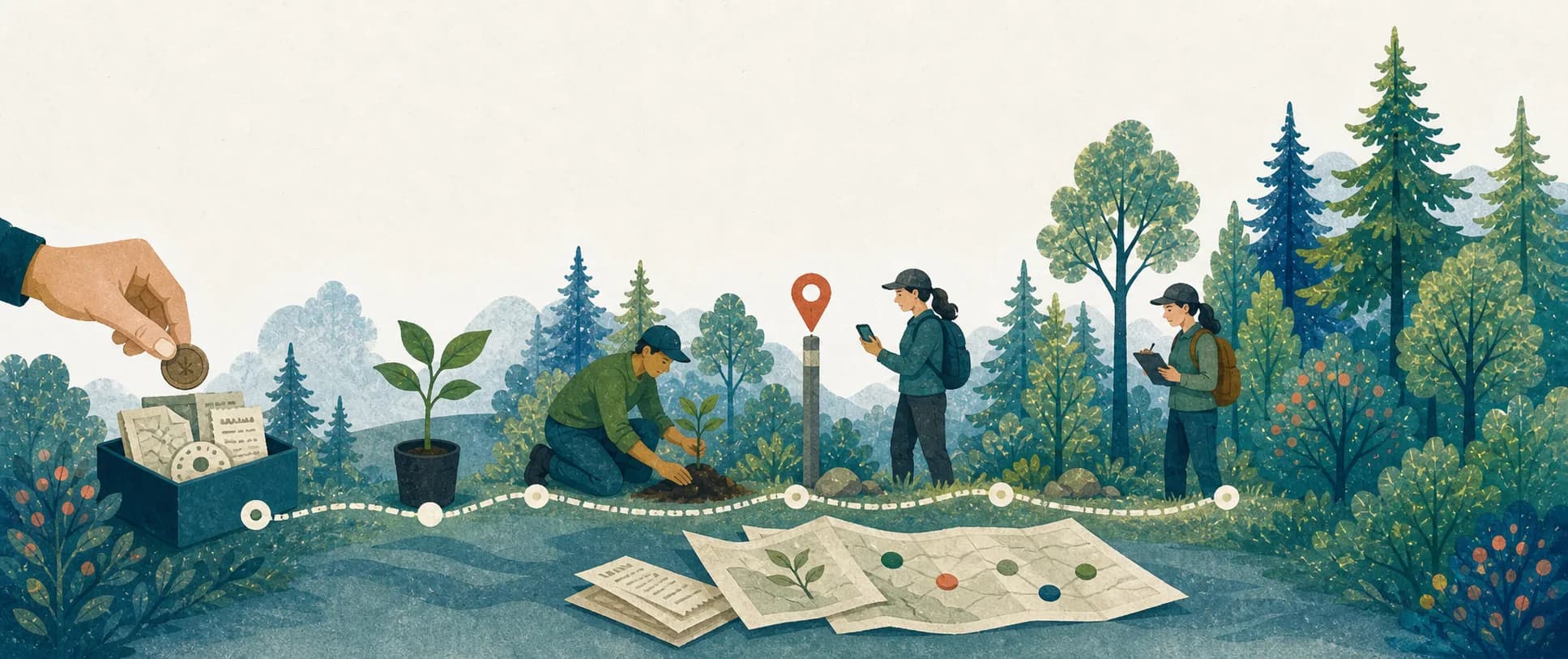
Verified tree planting means a documented chain connects funding to a real restoration project: a credible partner selects and prepares a suitable site, plants or supports natural regeneration, records the work and monitors what happens afterwards. Verification should make the partner, location, timing, quantity and counting method checkable.
A certificate is one piece of that evidence. It can confirm that money was allocated or a planting batch was completed, but it cannot guarantee that every seedling survives, that an ecosystem is restored or that a fixed amount of carbon will remain stored. Those stronger outcomes require maintenance, field or remote monitoring and transparent follow-up over years. “Verified” should describe the evidence and process, not act as a magic quality label.
Good projects begin before planting day
Restoration starts by understanding why tree cover was lost, who uses the land and what the ecosystem can support. Planting on the wrong land, choosing unsuitable species or ignoring grazing, fire and tenure can produce a photogenic event with little lasting value.
A credible project has legitimate access to the site and involves affected communities. It defines the ecological goal: native forest recovery, agroforestry, watershed protection or another locally appropriate outcome. Sometimes assisted natural regeneration is better than rows of nursery seedlings.
The IUCN Global Standard for Nature-based Solutions evaluates interventions across biodiversity, society, economics and adaptive management. Its breadth is useful because a tree count alone cannot reveal whether a project respects rights or strengthens a resilient ecosystem.
The baseline matters as well. Restoring a degraded native ecosystem is different from replacing an existing grassland or diverse woodland with a single commercial species, even if both increase a tree counter.
Funding has to map to a defined batch
The financial chain should identify who received the funds, the project they support and what unit is being purchased. “One tree funded” may cover seedlings, labour, transport, site preparation, maintenance and monitoring rather than a retail object handed directly to the buyer.
Projects often aggregate contributions into batches because nurseries and field teams work seasonally and at landscape scale. A good record states the planting period and location, number or area supported, partner name and the meaning of the count. It avoids implying that the sponsor owns an individual tagged tree unless that is genuinely the system.
Treechat uses this batch model: every paid member funds one newly planted tree for each month of membership through verified reforestation partners, and certificates are published as batches land. The commitment is a membership benefit, not a carbon conversion. The current statement and impact calculation boundaries are on /methodology.
Batch records should remain accessible after publication so later monitoring can be connected to the same project rather than presented as an unrelated success story.
A certificate proves only what it says
A partner certificate can document a donation, allocation or completed planting batch. Readers should check the issuer, date, project, location and quantity, and whether supporting reports are available. Vague certificates with no project reference are harder to scrutinise.
The document is not automatically an independent audit. A partner may certify its own delivery, an external assessor may verify selected records, or a carbon standard may validate a much more detailed methodology. These are different levels of assurance and should be named accurately.
A planting certificate is also not necessarily a carbon credit. Carbon credits require defined baselines, quantification, additionality, leakage and permanence rules, plus registry controls. Verra’s afforestation and reforestation methodology, for example, quantifies removals under a formal standard. Ordinary tree funding should not borrow that tonne-based meaning.
Even within formal standards, validation and later verification are distinct stages. Supporters should read the project status rather than assuming registration proves every future removal has already occurred.
Planting is followed by establishment
Seedlings face drought, flooding, fire, pests, browsing and competition. Projects may need watering, weed control, firebreaks, protection or replacement planting. Survival varies by site and method, so one universal percentage would be misleading.
The Food and Agriculture Organization’s restoration guidance recommends early checks of planting quality, monitoring growth and survival after several months, assessment around the dry season and replanting failed areas where needed. Subsequent maintenance can continue for years.
Responsible reporting therefore labels the stage. “Funded”, “planted”, “surviving at the first check” and “established” are not interchangeable. If only a funding or planting certificate is available, the claim should stop there until monitoring evidence arrives.
Replacement policies need plain language. Some partners replant losses within a defined establishment period; others fund a broader landscape outcome. Neither approach should be inferred from the word “verified”.
Maintenance also needs a budget and an accountable party. Paying for a seedling without supporting the work that helps it establish can shift risk to local organisations and communities.
Verification should mature over time
Initial evidence can include invoices, nursery records, geotagged field reports and partner certificates. Later evidence may add sample-plot surveys, survival checks, photographs, satellite monitoring and maintenance reports. No single tool is sufficient everywhere: young or scattered trees can be difficult to detect remotely, while field samples cover only part of a landscape.
Monitoring should test more than tree presence. Species diversity, natural regeneration, soil, disturbance and community outcomes can show whether a functioning ecosystem is developing. The FAO and World Resources Institute’s restoration monitoring guide highlights mapping tree cover alongside other indicators for tracking landscape progress.
Projects should report setbacks as well as successes. Fire or low survival does not necessarily mean the original funding was fraudulent, but it does require explanation, adaptation and, where promised, replanting.
Comparable reports use the same boundary from one period to the next. Changing from seedlings planted to hectares influenced can be legitimate, but the old and new measures should not be combined into one uninterrupted total.
Carbon claims require extra care
Trees remove carbon as they grow, not at planting. The amount depends on species, climate, soil, management and time. Stored carbon can return to the atmosphere through fire, disease, harvest or land-use change. A simple number of seedlings cannot establish tonnes of durable removal.
Additionality asks whether the restoration happened because of the funding rather than being legally required or already financed. Leakage asks whether damaging activity moved elsewhere. Permanence addresses reversal risk. These questions are necessary for an offset claim but may sit outside a basic planting certificate.
Treechat does not use funded trees to mark AI messages carbon neutral and does not subtract future tree growth from its operational receipt. The planting commitment sits beside efforts described in the AI chat that plants trees, not in place of reduction.
That boundary protects both claims. The chat receipt remains an operational estimate, while restoration evidence can be evaluated on ecological terms rather than forced into an unsupported offset equation.
What to look for as a supporter
Look for a named partner and project, an understandable funding unit, location and date, appropriate species and land rights, maintenance plans and later monitoring. Ask whether evidence is partner-issued or independently audited and whether a tree, hectare or carbon tonne is actually being claimed.
Then keep the wider hierarchy clear. Tree planting can support restoration, but avoiding emissions and reducing resource use remain necessary. How to reduce your AI carbon footprint covers direct computational choices; a practical guide to sustainable AI covers system design and reporting.
Verified planting is best understood as an evidence trail that grows with the project. Funding records establish the start, certificates document a batch, and monitoring tests whether the ecological work endures. Honest programmes publish each layer when it exists and do not claim the next one early.
Supporters can revisit the record rather than treating the transaction as finished on planting day. Long-term transparency is more valuable than a precise counter with no history behind it.