How much electricity does AI use?
AI electricity use has no single meter. Here is what global data-centre totals tell us, what they leave out and how to read the forecasts.
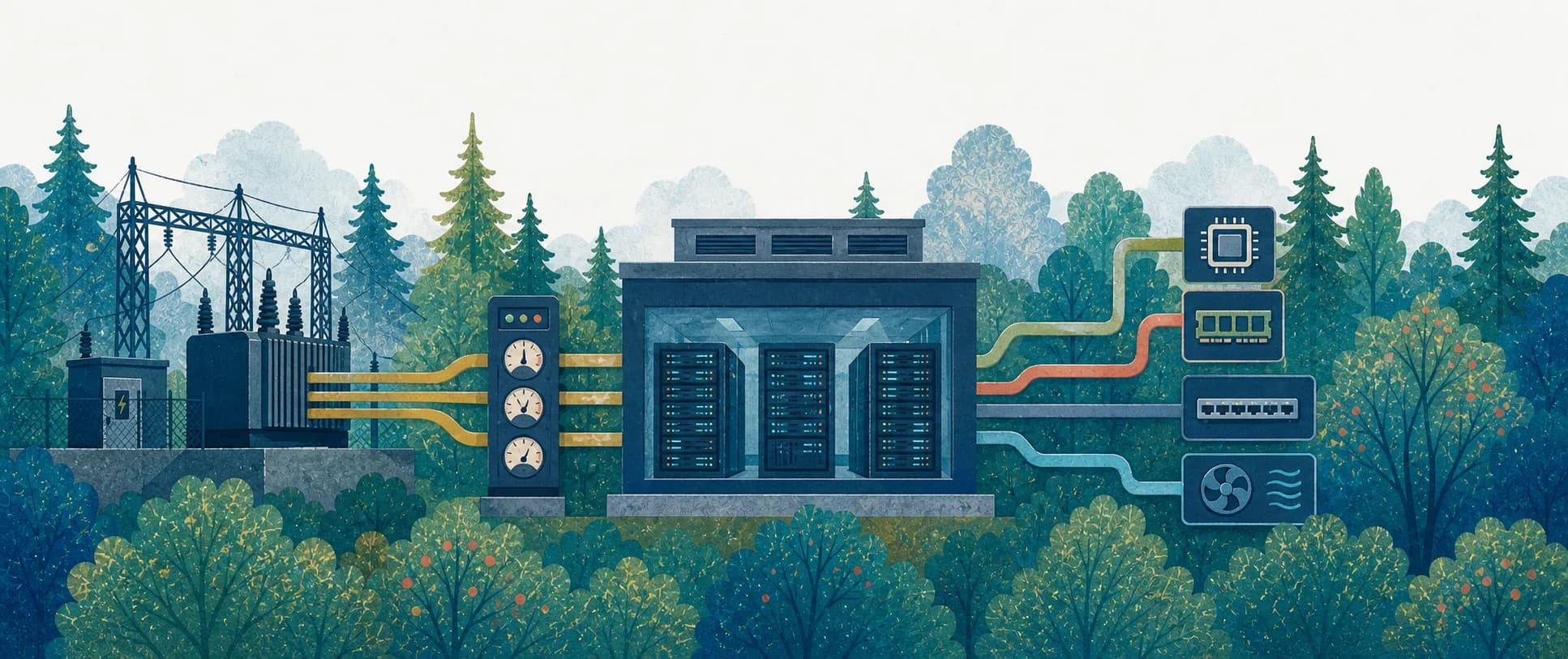
There is no reliable global total for electricity used by AI alone. AI runs inside data centres alongside cloud storage, video, conventional software and other workloads, and operators rarely publish enough detail to separate them. The best honest answer therefore starts one level up.
The International Energy Agency estimates that all data centres used about 415 terawatt-hours of electricity in 2024, around 1.5% of global electricity consumption. Its base case projects about 945 TWh in 2030 and identifies AI as the most important driver of the increase, alongside growth in other digital services. Those are modelled data-centre figures, not a reading of “AI electricity”.
For one ordinary text message, recent public estimates are much smaller—generally a fraction of a watt-hour—but model choice, context and output length can change the result substantially.
Why the global AI number is missing
A data-centre electricity meter sees servers, networking, storage, cooling and power conversion. It does not label each electron “AI inference”, “model training” or “email”. A provider can allocate energy internally, but public reporting usually combines services or reports company-wide totals.
Even the category of AI is slippery. A recommendation model, a weather model, an image generator and a long-reasoning chatbot are different workloads. Some share accelerators with other customers. Others use dedicated clusters. A server may also consume power while waiting for work, which has to be allocated somehow if the goal is a per-task figure.
This is why a precise global AI total should prompt questions about the boundary and method. It may be a scenario, a capacity estimate or a subset of hardware rather than directly measured consumption.
The IEA’s 415 TWh estimate gives scale without pretending that every data-centre task is AI. It also shows why a small global percentage can coexist with serious local pressure. Large facilities cluster in particular regions and connect to specific grids, so their effect is not evenly spread across the world.
For the United States, Lawrence Berkeley National Laboratory’s 2024 data-centre energy report models historical use and a range of scenarios to 2028. The use of a range matters: future demand depends on accelerator shipments, utilisation, efficiency improvements and how quickly new sites are completed.
EPRI likewise publishes scenarios rather than one certain future. Its Powering Intelligence analysis projects a wide spread in US data-centre electricity use by 2030. Forecasts differ because their inputs and cut-off dates differ, not necessarily because one side has found a hidden meter.
A message is not a fixed unit
At the individual level, the question becomes more concrete but still needs context. An AI message can be a ten-word rewrite or a request that processes a large document, searches the web and produces several thousand words. Each involves a different amount of computation.
Recent estimates discussed in how much energy a ChatGPT query uses place a typical text exchange around a fraction of a watt-hour. Long inputs, extended reasoning, multiple tool calls and image or video generation can be far more demanding. The energy cost also changes with the model, hardware, batching and data-centre overhead.
That variation is why multiplying one popular “per query” figure by all AI use produces a fragile total. The assumed message mix can dominate the answer.
Training and inference both count
Training is the concentrated job that creates or substantially updates a model. Inference is the repeated work performed when people use it. Training can consume a large amount over a finite period; inference begins afterwards and grows with every request.
Which one is larger over a model’s life cannot be answered without knowing how often the model is used. A widely deployed service can accumulate enormous inference demand. A model trained and then seldom used may remain training-heavy. Allocating training energy per message also requires guessing the model’s lifetime usage.
The distinction is explored further in AI training versus inference emissions. For electricity planning, both workloads contribute to facility demand. For a per-message receipt, operational inference is usually the more defensible boundary because it relates to the work just requested.
Efficiency does not guarantee lower totals
Hardware and software can deliver more AI work per watt. Smaller models can reduce computation, quantisation can reduce memory and arithmetic requirements, and higher utilisation can spread a server’s overhead across more requests. The IEA includes a high-efficiency scenario precisely because these changes could materially lower future demand relative to its base case.
But efficiency per task and total electricity use are separate questions. If AI becomes cheaper and is placed in more products, the number and complexity of tasks can grow faster than energy per task falls. New capabilities can also create workloads—such as persistent agents or generated video—that were not common before.
That is the central answer to why AI uses so much energy: demanding computation is becoming both more efficient and more widely used.
How to read an AI electricity claim
First ask whether the claim covers AI, accelerated servers or all data centres. Then check whether it is measured consumption, estimated energy or projected capacity. Look for the year, geography, utilisation assumption and whether cooling and power conversion are included. Finally, keep electricity separate from carbon: the same watt-hour can have different emissions depending on where and when it is generated.
Treechat’s message receipt is deliberately narrower than a global forecast. It estimates operational energy from the model and token use, adds stated data-centre overhead and converts it using a disclosed grid assumption. It is not a power-meter reading or a claim about the whole life cycle. The current inputs and limits are on our methodology page.
So how much electricity does AI use? Enough to be a material driver of data-centre growth, but not enough for the public evidence to support one exact AI-only total. Use system-level ranges for grid questions and task-level estimates for individual choices—and do not confuse the two.