Do small AI models use less energy?
Usually, yes—but parameter count is not a power meter. Architecture, hardware, tokens, batching and whether the model completes the task all matter.
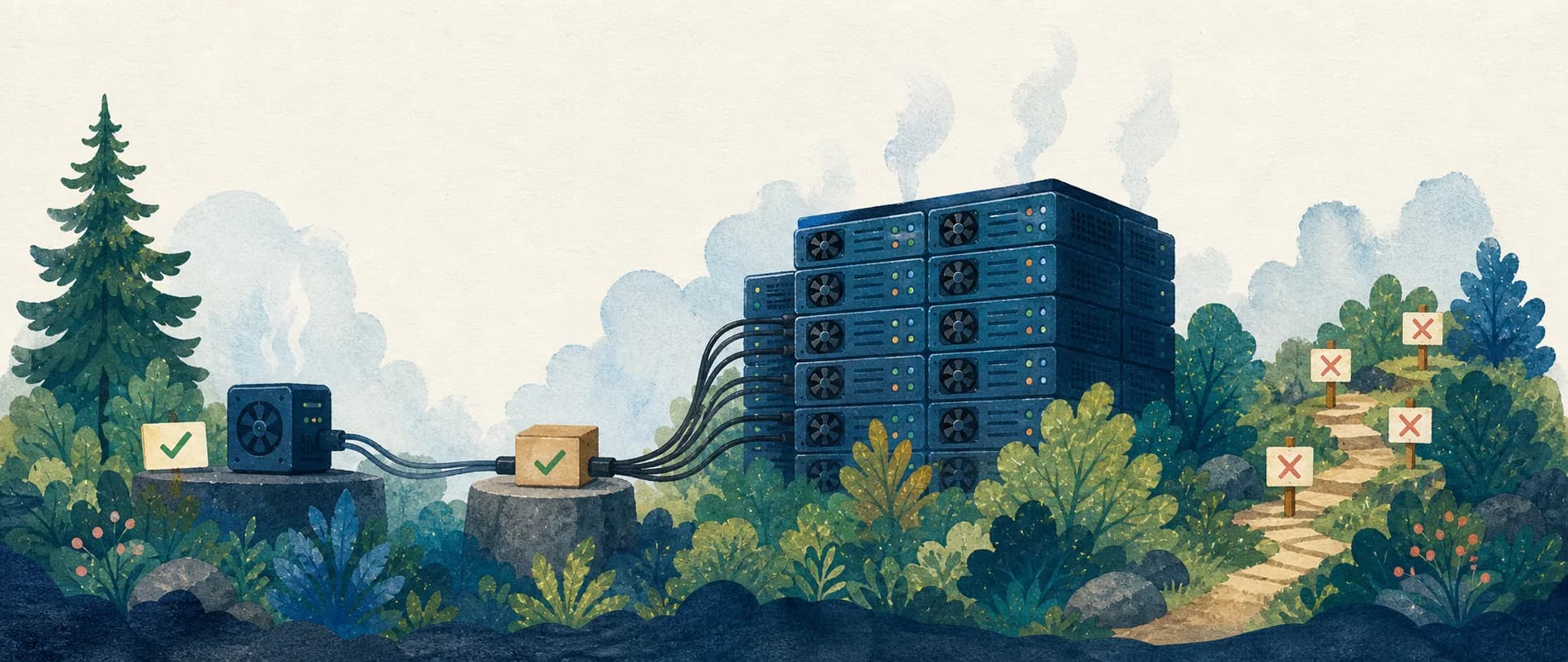
Small AI models usually use less energy per token than large models under comparable conditions. They generally perform fewer calculations and move less parameter data through memory. That makes model size one of the most practical levers for reducing the energy of everyday AI.
But “small” is not a complete measurement. A well-optimised larger model on modern hardware can sometimes serve a task efficiently, while a small model running poorly or repeating failed attempts may waste energy. Architecture, numerical precision, input and output length, batching and data-centre overhead all affect the result. The right claim is therefore: choose the smallest model that can reliably complete the task, then measure or estimate the whole job.
Why fewer parameters usually help
Parameters are the learned numerical values a model uses to transform an input and predict an output. For a dense language model, each generated token involves operations across much of the model and movement of weights from memory. Reducing the number of parameters usually reduces both kinds of work.
Smaller models can also fit more easily on fewer accelerators. That can reduce communication between chips and make serving simpler. When a service handles many users together, batching can spread fixed overhead over several responses.
These are physical reasons, not a guarantee attached to a product label. A provider still needs to disclose or estimate the relevant model, hardware and usage if it wants to quantify a saving.
Parameter count does not tell the whole story
A model can be compressed through lower numerical precision, often called quantisation. It can be pruned, distilled from a larger teacher or trained to use computation more selectively. Software kernels and accelerator design also determine how efficiently the theoretical operations become actual answers.
Mixture-of-experts models make headline size particularly tricky. They may contain many total parameters but activate only a subset for each token. The active computation can resemble a smaller model even though the stored model is large. Routing, memory and communication still consume resources, so “active parameters” is informative but not a full energy figure.
Output length can overwhelm a simple size comparison too. A small model generating 4,000 tokens may do more total work than a larger model giving a correct 200-token answer.
Evidence supports matching models to tasks
Luccioni, Jernite and Strubell compared energy use across a range of machine-learning tasks in Power Hungry Processing. In their evaluated conditions, general-purpose generative models were more energy-intensive than task-specific systems for many tasks. The paper’s broader point is more useful than memorising one benchmark number: model and task choice materially change inference energy.
That evidence does not establish one ratio for every current chatbot. Hardware and models change, benchmark prompts differ from live traffic, and a specialised classifier cannot replace a general assistant for open-ended work. It does support avoiding a large generative model when a narrow, efficient tool solves the problem.
The same principle applies inside chat: routine rewriting and explanations may not need the model reserved for complex reasoning.
Capability and retries belong in the calculation
Energy per attempt is not always energy per completed task. If a model misunderstands instructions, invents details or cannot manage the context, users may regenerate, rephrase and eventually switch models. Those retries count.
Conversely, defaulting every request to the most capable available system spends additional computation on jobs that do not benefit from it. A good router can place common requests on a smaller model and escalate only when task complexity warrants it. The user should also be able to choose the larger option when accuracy or capability matters.
This is the practical link between model size and why AI uses so much energy: the computational burden depends on both the machine and the job asked of it.
Training a smaller model generally requires less computation than training a comparable larger one from scratch, all else equal. In practice, development may include architecture searches, failed runs, fine-tuning and distillation from another model. Public disclosures rarely provide a complete life-cycle total.
After release, inference grows with usage. A very popular small model may consume more operational electricity in aggregate than a seldom-used large one. That does not make the small model inefficient per answer; it shows why per-task efficiency and system-wide demand answer different questions.
Our guide to AI training versus inference emissions explains why no fixed percentage can divide the two without knowing a model’s lifetime usage.
What small models are good for
Small models are often a strong fit for rewriting, summarising moderate text, classification, extraction, straightforward explanations, brainstorming and common coding patterns. Running them locally can also help privacy, although the electricity efficiency of a laptop versus a well-utilised server depends on hardware and workload.
Larger models may earn their cost for difficult multi-step reasoning, specialised code, very long context or tasks where a weaker first answer creates expensive human rework. The environmental choice is not to accept poor quality. It is to avoid paying the frontier-model compute premium where capability does not change the result.
The energy cost of one AI message therefore needs a model and token count, not just the word “AI”.
How to make a fair comparison
Compare models on the same task, quality threshold and output length. Include failed attempts. State whether the figures cover chip energy or total facility energy, and whether hardware utilisation is comparable. Avoid turning parameter ratios directly into energy ratios without evidence.
Treechat uses a smaller model for everyday questions by default and lets the user choose a bigger option when the task needs it. Its receipt estimates operational energy from model and token use, with a disclosed allowance for data-centre overhead. It is a modelled comparison, not a direct meter reading; the current method is published at /methodology.
So yes: small models normally use less energy for comparable inference. Their real advantage appears when they are well served, produce a useful answer without retries and replace larger-model work—not when “small” is treated as a magic sustainability label.