AI carbon footprint explained
AI’s carbon footprint includes electricity, chips, buildings and supply chains. The result depends on boundaries, grids and carbon-accounting choices.
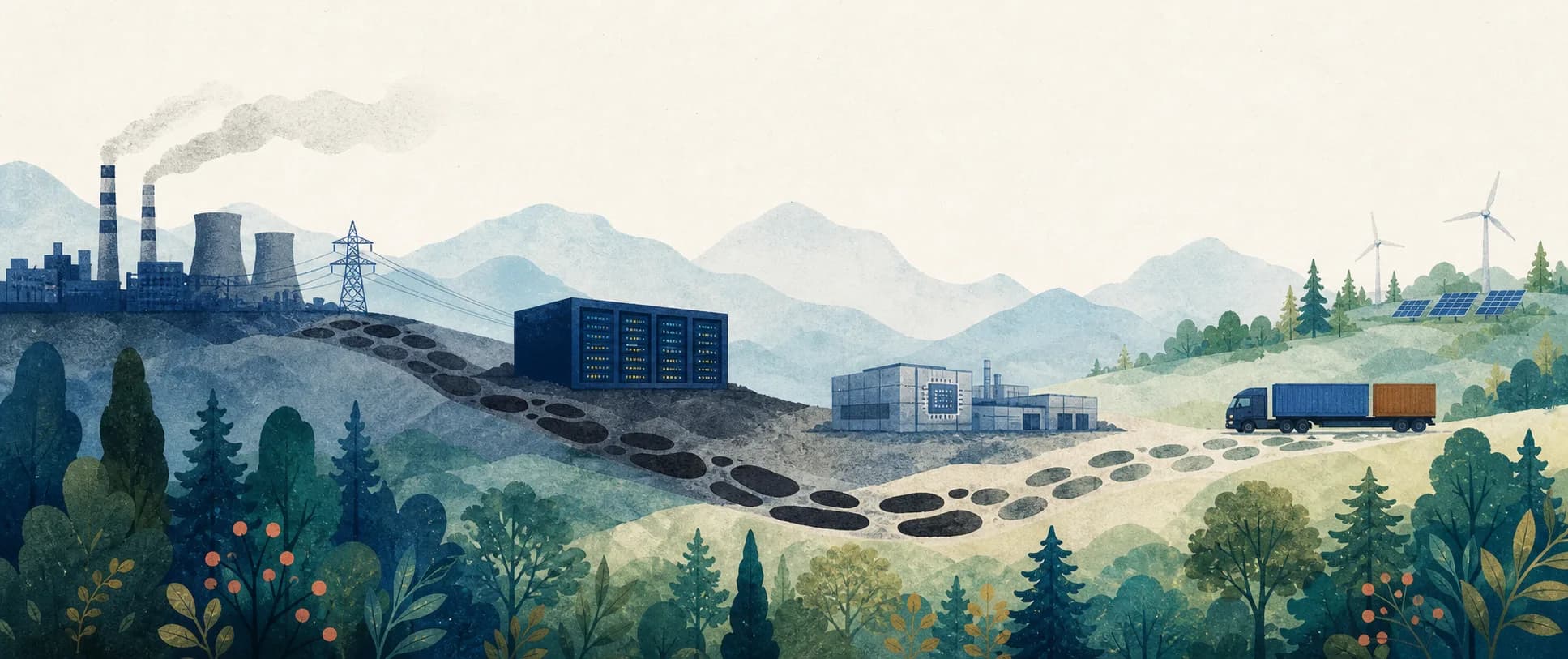
AI’s carbon footprint is the greenhouse-gas emissions caused across its life cycle: generating electricity for training and inference, manufacturing chips and servers, building data centres and operating the supporting supply chain. There is no single footprint for “AI” because models, tasks, locations and accounting boundaries differ.
Operational electricity is the most visible part and often the only part included in a per-query estimate. It is not the whole story. The carbon associated with one watt-hour changes with the grid supplying the data centre, while annual renewable-energy contracts can produce a different accounting result from the physical electricity available at a particular hour. A credible claim states what is counted, which carbon method is used and what remains unknown.
Electricity becomes carbon through the grid
Computers consume energy; emissions arise when that energy is produced. A data centre connected to a fossil-heavy grid can have higher operational emissions than one using the same electricity on a lower-carbon system. Grid intensity also changes by season and hour as demand and generation vary.
Analysts can use a location-based method reflecting the local grid, or a market-based method that accounts for contractual instruments such as power-purchase agreements and energy certificates. Both can answer legitimate questions, but they are not interchangeable.
The IEA’s analysis of electricity supply for data centres explicitly focuses on the physical generation mix rather than operators’ contractual mix. That choice makes its system-level emissions outlook different from a company inventory using market instruments.
Training and inference have different timelines
Training is a concentrated period of computation used to create or substantially update a model. Inference is the repeated computation after deployment: every generated answer, image or prediction. Development experiments and failed runs may add emissions before the released model exists.
Training can have a large headline footprint, but inference keeps accumulating with usage. Which dominates over the model’s life depends on how often it is called, how efficiently it is served and how long it remains in production. Allocating training emissions to one message requires an assumption about total lifetime messages.
AI training versus inference emissions examines why no fixed split works for every model. A per-message operational receipt should not quietly include a speculative training allocation and present it as measured.
Chips and buildings carry embodied emissions
Accelerators do not arrive without a footprint. Semiconductor fabrication uses energy, materials and complex global supply chains. Servers need racks and networking. Data centres use concrete, steel and electrical equipment. Replacing hardware creates end-of-life and recycling questions.
These are commonly reported as value-chain, or Scope 3, emissions by technology companies. Microsoft’s 2025 Environmental Sustainability Report said its total Scope 1, 2 and 3 emissions in the reported year were 23.4% above its 2020 baseline, with AI and cloud expansion among the growth-related factors. The company also reported lower operational Scope 1 and 2 emissions and higher Scope 3 emissions.
That combination shows why renewable electricity alone cannot make the complete life cycle disappear.
A company may match its annual electricity use with renewable generation while still drawing from the local grid when wind or solar is unavailable. It may report net-zero operations while pursuing a later target for the whole value chain. It may buy carbon removals for residual emissions.
Meta’s 2025 Sustainability Report says it matches 100% of its electricity use with clean and renewable energy and is working towards net zero across its value chain by 2030. Those are two distinct claims. Google’s 2025 Environmental Report reports energy and emissions progress while continuing to pursue carbon-free energy around the clock.
The reports are useful primary sources, but they are company accounting, not per-model audits. Read the scopes, baseline, instruments and assurance notes.
Per-message estimates are deliberately narrow
To estimate the operational carbon of a response, start with the electricity used by inference, add data-centre overhead if it is not already included, and multiply by an appropriate grid carbon intensity. Each input introduces uncertainty. Providers rarely expose model-level meter data, and a global average cannot capture a particular facility and hour.
The result can still help compare a short answer with a long one or a small model with a larger baseline. It should be labelled as an estimate and should not be described as the complete carbon footprint of AI.
Our guide to how much CO2 AI produces walks through the conversion and explains why apparently precise gram figures can overstate what is known.
Total emissions and individual choices are different views
At system level, the IEA projects that emissions from electricity generation for data centres reach around 320 million tonnes of CO2 by 2030 in its base case before declining slightly. It also says data centres would remain below 1% of global CO2 emissions. That is a data-centre forecast, not an AI-only inventory, and its physical-grid boundary should stay attached.
At task level, users can select a smaller capable model, request only the output needed and avoid unnecessary generations. Providers control larger levers: model architecture, hardware efficiency, utilisation, facility location, electricity procurement and supply-chain design.
How much electricity AI uses is part of the answer, but carbon requires the additional question: which electricity?
How Treechat reports carbon
Treechat estimates operational energy from model and token use, includes a stated data-centre overhead and converts it with a published average grid-intensity assumption. It cannot identify the exact facility or hourly power source for a response, and it does not present the receipt as a full life-cycle assessment. The assumptions and exclusions are on our methodology page.
Tree funding is reported as a separate action, not proof that computation was emission-free. That distinction matters. Reduction, clean electricity and durable carbon removal can all contribute, but none changes the historical fact that hardware was made and energy was used.
The best short explanation of AI’s carbon footprint is therefore a boundary, not a slogan: count operational and embodied emissions, distinguish physical grids from contractual claims, and preserve uncertainty instead of compressing the whole life cycle into one tidy number.