Renewable-energy data centres for AI: what the claim means
Renewables can cut AI's operational emissions, but annual matching is not round-the-clock clean power. Learn how data-centre electricity claims work.
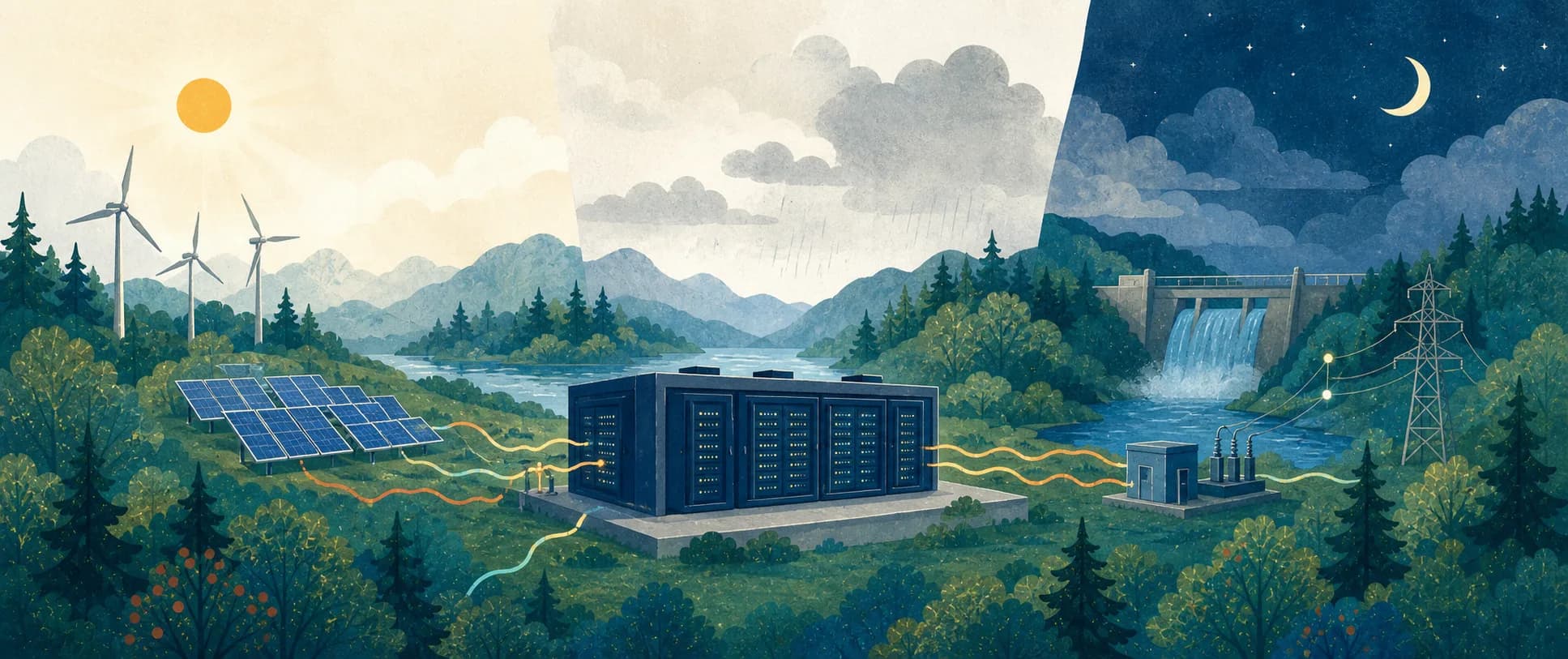
Renewable energy can substantially reduce the operational carbon emissions of AI data centres, but “powered by 100% renewable energy” can describe several different arrangements. A facility may use on-site generation, sign a power-purchase agreement or buy certificates equal to its annual electricity consumption. None necessarily means wind, solar or hydro supplied the facility in every hour.
The most informative claim states location, time period, technology, whether new generation was enabled and what supplied electricity when renewables were unavailable. It also keeps electricity separate from cooling water, construction and hardware manufacturing. Renewable procurement is a real lever; it is not proof that an AI service has no environmental footprint.
Data centres use the grid they are connected to
AI accelerators need continuous, high-quality power. Most data centres connect to a regional grid that mixes electricity from several sources. The physical electrons cannot be assigned to one corporate buyer, so operators use accounting instruments and contracts to support claims about renewable supply.
The International Energy Agency’s physical-grid analysis estimates that renewables supplied about 27% of electricity consumed by data centres globally in 2024. It projects renewables meeting nearly half of added data-centre demand to 2030, but natural gas and coal together supplying more than 40% of that growth in its base case.
Those figures cover all data centres, not AI alone, and are projections rather than promises. They show why a company’s contractual statement can differ from the regional generation actually responding to new load.
They also reveal a local issue hidden by global percentages. A large facility connects at one place, where available generation, transmission capacity and demand peaks determine the immediate system effect.
On-site power, contracts and certificates differ
On-site solar or wind can supply a facility directly when conditions allow. Space, weather and the constant scale of data-centre demand mean it rarely covers every hour without storage, other generation or the grid.
A power-purchase agreement, or PPA, is a longer-term contract with an electricity generator. It can give a new renewable project predictable revenue and help finance construction. The data centre may still draw from its local grid while the contracted project supplies another point on the network.
Renewable energy certificates record environmental attributes associated with generated electricity. Buying enough certificates to match annual consumption supports a market claim, but the generation may occur in different places or months. The IEA explicitly warns that annual renewable matching does not mean a data centre is exclusively powered by renewables.
These mechanisms can complement one another. A facility might use rooftop solar, contract with a new wind farm and buy certificates for the remainder, provided its reporting explains each layer.
Time and location make the claim stronger
Hourly matching compares consumption with low-carbon generation for the same hour, ideally on the same electricity system. This exposes evening and windless periods hidden by annual totals. It encourages procurement of storage, firm low-carbon generation and a more diverse supply rather than enough midday solar to balance a yearly spreadsheet.
Location matters because a contract in a renewables-rich region may do little for a fossil-heavy grid hosting the data centre. The best evidence includes both location-based emissions, reflecting the physical grid, and market-based figures reflecting contracts.
Even hourly matching is an accounting approach, not a claim that a private cable connects each server to a particular turbine. Grid balancing, losses and shared infrastructure remain. Still, more precise time and location information better aligns procurement with the emissions the load can influence.
Public reporting should show the unmatched hours too. A percentage without the remaining supply mix makes it difficult to see whether residual demand is served by gas, coal, nuclear, storage or imports.
Additionality asks what changed
A renewable purchase has greater system value when it helps create clean generation that would not otherwise have been built or keeps a threatened resource operating. Buying inexpensive certificates from an existing project may accurately meet a contractual rule while causing little new capacity.
Additionality is difficult to prove because electricity investment has many causes: policy, market prices, grid access and several buyers. Look for long-term contracts, project names, commissioning dates and evidence that demand supported finance. Avoid treating one attribute as a complete verdict.
There are trade-offs too. A new project needs land, materials and network connections. Good procurement considers biodiversity, local consent and community benefit alongside carbon. “Renewable” describes the energy source, not every consequence of the project.
Claims are strongest when contracts and project data are public enough to inspect. A generic statement about supporting clean energy offers less evidence than named projects, dates, volumes and the accounting standard used.
Reliability does not require abandoning renewables
AI services often need power around the clock, while wind and solar vary. A reliable lower-carbon system can combine geographically diverse renewables, transmission, batteries, demand flexibility and firm sources. Backup generators may remain for outages; their fuel and testing emissions should be reported.
Flexible computation can help. Training, data preparation and some batch inference can move away from high-carbon hours if deadlines and data rules permit. Interactive chat has less timing flexibility because users expect immediate replies, so clean supply and efficient serving matter more.
Efficiency remains the first lever. The IEA’s scenarios show future demand changing materially with hardware, software and utilisation assumptions. Lowering the electricity needed for each useful task makes round-the-clock clean supply easier to achieve. See a practical guide to sustainable AI for application-level actions.
Grid operators also need visibility. Connection studies, realistic ramp rates and demand-response agreements can help a large load arrive without forcing avoidable fossil generation or weakening reliability for other users.
Renewable power does not cover the whole footprint
Low-carbon electricity reduces operational emissions; it does not undo chip fabrication, server replacement, construction or water consumption. Some cooling systems consume water on-site, while power generation can add indirect water use. A full environmental assessment needs these categories even if the electricity claim is sound.
Nor should clean energy be used to excuse unlimited demand. New data-centre loads can compete for grid connections and affect local power planning. Absolute electricity use, peak demand and the sources built to meet growth belong beside an intensity figure.
This is why green AI combines energy efficiency, hardware efficiency and carbon-aware operation rather than relying on procurement alone. Small language models and focused applications can reduce the load before cleaner electricity supplies it.
Water and carbon can also pull in different directions. Cooling choices and electricity sources should be assessed together, especially in hot or water-stressed regions, instead of optimising one global number.
Local reporting makes that trade-off visible.
How to evaluate an AI provider's claim
Ask whether “100% renewable” means annual certificates, a PPA, on-site generation or hourly local matching. Request the reporting year, geography, residual grid mix and treatment of backup power. Check whether the claim covers the facility, the whole company or the specific AI service.
Treechat does not know the exact facility or hourly electricity source behind each provider-run response. Its receipt therefore applies a stated average grid carbon factor to estimated operational energy rather than claiming renewable power. The model, token, overhead and grid assumptions are published at /methodology.
For users, the practical sequence is to reduce unnecessary computation, choose the smallest capable model, then prefer providers with credible, increasingly time- and location-matched clean electricity. Our guide to reducing your AI carbon footprint explains why that sequence is more defensible than a green badge.
No consumer can audit a grid from a chat window. Providers should carry the disclosure burden, while users and business customers can reward claims that are specific, dated and open to correction.