How many trees offset AI usage?
There is no honest fixed number of trees per AI prompt. Learn what must be measured before AI emissions and woodland carbon can be compared.
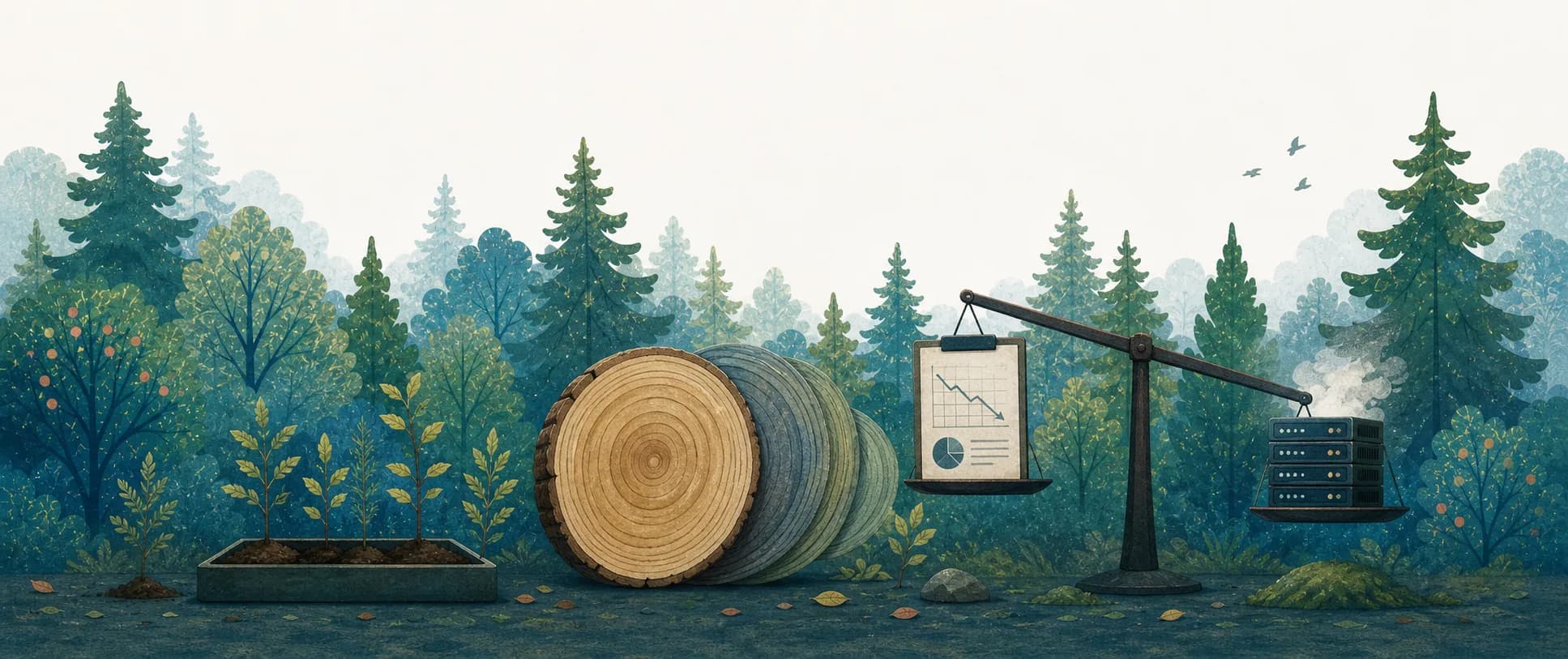
There is no credible universal number of trees that offsets AI usage. To calculate one, you would need the AI system’s emissions over a defined period and the verified carbon captured by a particular woodland project over decades. Neither side is a fixed “per prompt” constant.
A short answer from a small model and a long, tool-using response can require very different amounts of electricity. A tree’s carbon storage also changes with species, climate, soil, survival, management and time. Planting one tree is therefore a useful contribution only when it is backed by a real project; it is not evidence that a message became carbon-free. Reduction comes first, transparent estimation second, and climate funding remains separate.
Start with the AI emissions boundary
“AI usage” could mean one text answer, a year of employee use, training a model or operating an entire service. A calculation has to choose one. For day-to-day chat, the narrowest practical boundary is usually operational inference: estimate the electricity used to process and generate tokens, include data-centre overhead, then apply an electricity carbon factor.
That still produces an estimate, not a meter reading. Model architecture, response length, hardware utilisation and facility location are often undisclosed. Training, chip manufacture, data-centre construction, networking and the user’s device may sit outside the boundary.
The International Energy Agency’s Energy and AI report uses system-level scenarios because data centres contain AI and non-AI workloads and future demand is uncertain. A global forecast cannot simply be divided into a trustworthy footprint for your message.
Treechat’s methodology uses a narrower operational estimate based on model and token use, with stated data-centre and grid assumptions. It does not claim a full life-cycle measurement.
A tree is not a standard carbon unit
Two seedlings planted on the same day may follow very different paths. One may fail to establish. Another may grow for decades. Species, rainfall, fire, pests, harvesting and land management affect how much carbon remains stored. Soil can gain or lose carbon too.
This is why robust programmes calculate carbon at project level rather than attaching a universal kilogram figure to every sapling. The UK Woodland Carbon Code requires projects to model sequestration by species and management, subtract establishment and soil-disturbance emissions, account for the baseline and leakage, and update projections when verified performance changes materially.
Time matters just as much as volume. AI electricity is consumed now; woodland carbon accumulates later. A promised future removal is not the same thing as avoiding a tonne of emissions today. Good accounting keeps the planting date, expected sequestration period and verification status visible.
Why the simple division fails
The tempting formula is “AI carbon per message divided by carbon per tree”. Its appearance of precision hides mismatched boundaries. The numerator may be a modelled operational average. The denominator may be a lifetime projection that assumes survival and continuing stewardship. Dividing them does not repair either uncertainty.
It can also invite double counting. A project’s carbon benefit cannot honestly be claimed by a platform, a planting partner and every user as if each owned the whole outcome. Verified carbon units need clear ownership, a registry and rules for reversals. A planting receipt proves funding or planting; it does not by itself prove how much carbon has already been removed.
For these reasons, Treechat describes monthly member-funded planting as a separate contribution, not an exact offset for AI usage. The distinction is central to how environmental claims should be read: a funding commitment and a carbon-neutrality claim are different statements requiring different evidence.
What an honest estimate would require
If an organisation genuinely needs a tree equivalent, begin with a defined reporting period and an emissions inventory. Separate operational inference, training allocations, purchased cloud services and embodied hardware where the data permits. Record whether electricity emissions use a location-based grid mix or a contractual market-based method.
Then choose a specific forestry project with published documentation. Check its baseline, additionality, species plan, project duration, monitoring schedule, reversal buffer and third-party verification. Use the project’s claimable carbon units by vintage, not a generic internet average per tree. The Woodland Carbon Code’s measurement overview shows why growth projections are monitored and updated rather than assumed once.
Even after that work, describe the result as an accounting equivalence. It does not make the original energy demand disappear, solve local water use or cover environmental impacts outside the selected carbon boundary. A careful estimate is useful for budgeting climate finance; it should not become a guilt-free label.
Reduce first, then fund credible work
The most immediate intervention is to avoid unnecessary computation. Use search, a calculator or conventional software when it solves the task. Choose a smaller capable model for routine drafting and reserve long-context reasoning, agents, image generation and repeated variants for work that warrants them. Our guide to choosing an AI assistant by energy use explains what evidence to look for.
Climate funding can then sit alongside reduction. Ask where trees are planted, who owns the land, how survival is checked, whether native ecosystems are protected and what happens after fire or failure. Tree counts are easy to communicate; durable ecological outcomes take longer to demonstrate.
Students can use the same questions in a student’s guide to AI environmental impact. The conclusion is deliberately less tidy than a conversion chart: no fixed number of trees offsets AI usage. Measure the defined emissions, support a verified project and report the two honestly without pretending planting erases the need to use energy wisely.